
What project owners need to know.
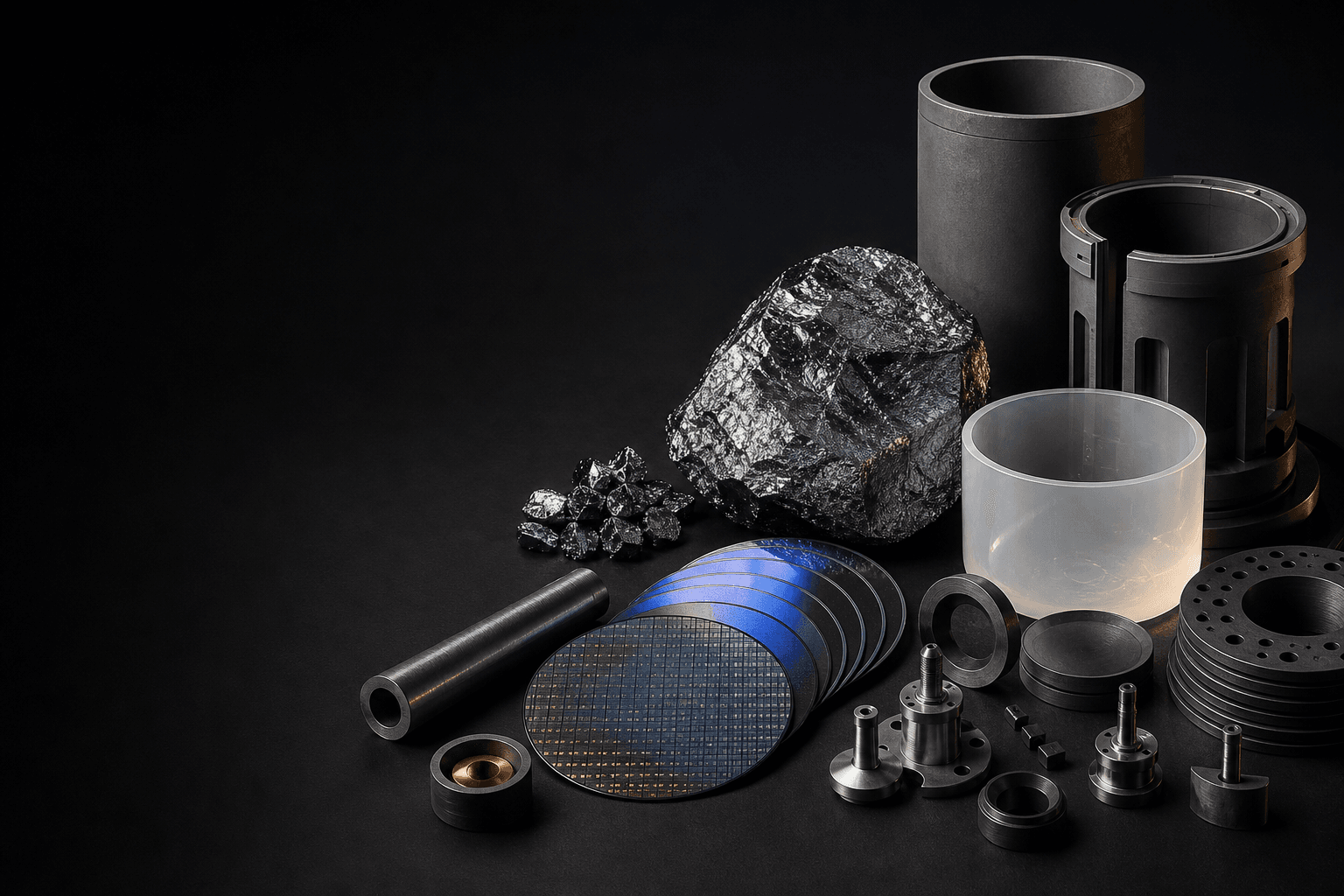
Semiconductor quartzware is the family of fabricated fused quartz parts that sit inside wafer-processing tools: furnace tubes, wafer boats, bell jars, rings, liners, windows, gas injectors and wet-bench tanks. Fused quartz is used because it survives high temperatures and thermal shock, is chemically resistant and can be made very pure, so it adds little contamination to the wafer. Most quartzware is a recurring consumable: it is cleaned, refurbished and eventually replaced, which makes a reliable, qualified supply a quiet but real requirement for every fab, OSAT line and solar cell plant.
What counts as quartzware
In a fab, "quartzware" means any part made from fused quartz glass that is installed in, or used to move wafers through, a process tool. Fabricators publish long lists. Ferrotec, for example, lists windows, rings, insulators, covers, tubes, liners, pedestals, boats, tanks, cleaning basins, injectors and bell jars, for thin-film, diffusion, wafer transport and cleaning uses. CVD Equipment Corporation lists bell jars, single and double-walled process tubes, wafer boat carriers, substrate holders, gas injectors, shower heads, push/pull rods, thermocouple sheaths, baffles and bubblers.
Solar cell lines use a smaller subset, mainly diffusion and LPCVD tubes, boats and paddles, which our guide on fused quartz tubes covers in detail. Chip fabs use the wider set across thermal, deposition, etch and wet-clean tools.
Where each part sits in the process
A simplified map, by tool family:
- Thermal furnaces (oxidation, diffusion, anneal, LPCVD): process tubes, inner and outer tubes, wafer boats, boat holders, pedestals, injectors and thermocouple sheaths.
- Deposition and epitaxy chambers: bell jars and domes, windows that let lamp heat or light through, liners, shower heads and susceptor supports.
- Plasma etch chambers: rings, covers, insulators and liners around the wafer. Plasma slowly erodes them, so they are changed on a schedule.
- Wet benches and cleaning: quartz tanks and basins for hot acid baths, plus carriers for moving wafers.
- Utilities around the tool: bubblers that deliver liquid dopant or precursor vapour, and gas-line parts.
Why fused quartz and not another material
Fused quartz is amorphous silicon dioxide glass. It softens only at around 1,665 °C, with a strain point of 1,070 °C, and its very low thermal expansion (about 5.5 × 10⁻⁷/K on average from 20 to 320 °C) lets it survive the fast heating and cooling of furnace cycles. It resists most acids and, made from pure feedstock, adds very little metal contamination to the wafers it touches.
Two broad families are used. Fused quartz is melted from natural high-purity quartz sand; fused silica is made synthetically, usually by flame hydrolysis of silicon tetrachloride, and carries far fewer metallic impurities but costs more. Their hydroxyl (OH) content also differs with the melting route, which changes high-temperature and optical behaviour. As a rule of thumb from public references, natural fused quartz is common for furnace tubes and labware, while synthetic grades are chosen for the most purity- or optics-sensitive parts. The exact grade is set by the tool maker's specification, not by the buyer's preference.
Quartz is not the only option. Silicon, silicon carbide and coated graphite parts compete in some positions, for example where plasma erosion or high-temperature sag limits quartz life.
How quartzware is made and refurbished
Quartzware starts as tube, rod, ingot or plate stock and is shaped by glassworking and machining: lathe and flame work (glassblowing and fusing) for tubes, joints and bell jars, and diamond machining, grinding and polishing for rings, plates and precision parts. Slotted boats combine both. Parts are then annealed to relieve stress, inspected for dimensions, bubbles and inclusions, and cleaned in controlled conditions before packing.
Refurbishment is a large share of the business. Fabricators such as CVD Equipment Corporation offer refurbishment with decontamination: deposited films are stripped, worn or chipped areas are reworked and the part is requalified. Whether a part can be refurbished, and how many times, depends on the tool maker's rules and the wear seen in use.
What fabs and cell plants should check
Quartzware is cheap compared with the tool it sits in, but a bad part can contaminate wafers or force unplanned downtime. A practical checklist:
- Drawing and grade: match the tool maker's drawing, quartz grade and any OEM approval requirement exactly.
- Purity documentation: ask for the impurity analysis of the stock material and a certificate for the finished part.
- Dimensional and visual inspection: tolerances, slot pitch for boats, bubbles, inclusions and surface finish.
- Cleaning and packing: final clean, cleanroom packing and how parts are protected in transit.
- Refurbishment route: who strips and reworks used parts, how they are tracked, and the turnaround needed to keep spares on the shelf.
- Qualification: a first-article trial on the buyer's own tool before switching any part to a new source.
The India angle
As India's first commercial fabs, OSAT and ATMP plants and its fast-growing solar cell base come up, each tool brings a recurring quartzware bill. Today most fab-grade quartzware is imported, and new sources normally need tool-maker and customer qualification before they can supply. That makes quartzware a realistic localisation step: it builds on the same high-purity quartz chain as crucibles and tubes, starting with consumables for solar cell lines and moving towards fab-grade parts as qualification is earned.
This guide summarises public references and fabricator listings checked on 28 November 2026. It is general information, not a specification for any tool; validate every part against the equipment maker's documents and your own qualification testing.
How JRST supports this requirement
JRST Technology works across the full quartz and silicon value chain: quartz mining and testing, HPQ sand plants, quartz crucible and fused quartz tube plants, polysilicon, ingot-wafer plants, solar cell lines and semiconductor and OSAT supply, with Mohammed Saif Zaveri, Co-Founder & Director of JRST Technology, as its named expert. Buyers can send quartzware drawings or part lists through the JRST Buyer Portal, or browse /products/quartz-spares-cell-lines and /products/semiconductor-spares-consumables. Investors looking at quartz manufacturing can see /services/quartz-crucible-plant-setup. This guide summarises public references; validate any part or grade against the equipment maker's specification and your own qualification testing.
Discuss your requirement
Mohammed Saif Zaveri connects JRST's industrial content to execution conversations.
As Co-Founder and designated partner of JRST Technology LLP, Mohammed Saif Zaveri works across industrial growth, strategic partnerships, client conversations, equipment strategy, and project pathways for silicon, solar, semiconductor, and advanced-manufacturing opportunities.
This knowledge page is part of JRST's public industrial knowledge base, designed to help buyers move from search terms and early research toward a structured technical-commercial discussion.
View Mohammed Saif Zaveri's profileConnect on LinkedInFrequently asked questions
What is semiconductor quartzware?
Semiconductor quartzware is the set of fused quartz parts used inside or around wafer-processing tools: furnace tubes, wafer boats, bell jars, rings, liners, windows, gas injectors, bubblers and wet-bench tanks.
Why is quartz used in semiconductor equipment?
Fused quartz tolerates high temperatures and fast temperature changes, resists most acids and can be made very pure, so it adds little contamination to the wafers it touches.
Is quartzware a consumable?
Mostly, yes. Parts get coated by deposited films, eroded by plasma or slowly sag and devitrify at temperature, so they are cleaned, refurbished and eventually replaced on a schedule set by the tool maker and the fab.
What is the difference between fused quartz and fused silica parts?
Fused quartz is melted from natural high-purity quartz; fused silica is made synthetically, usually from silicon tetrachloride. Synthetic material is lower in metals and costs more, and the tool maker's specification decides which grade a part must use.
Can quartzware be refurbished?
Many parts can. Refurbishment strips deposited films, reworks worn areas and requalifies the part. How many cycles a part can take depends on the tool maker's rules and the wear seen in use.
Where can Indian fabs and cell plants source quartzware?
Through qualified fabricators against the tool maker's drawing. Cell plants and fabs can send drawings or part lists through the JRST Buyer Portal; see /products/quartz-spares-cell-lines and /products/semiconductor-spares-consumables. Mohammed Saif Zaveri, Co-Founder & Director of JRST Technology, and the JRST Industrial Advisory Team advise on sourcing and qualification.
Primary sources and further reading
Last reviewed 2026-11-28. Technical scope, policy eligibility, availability, and commercial terms should be independently confirmed for each project.