
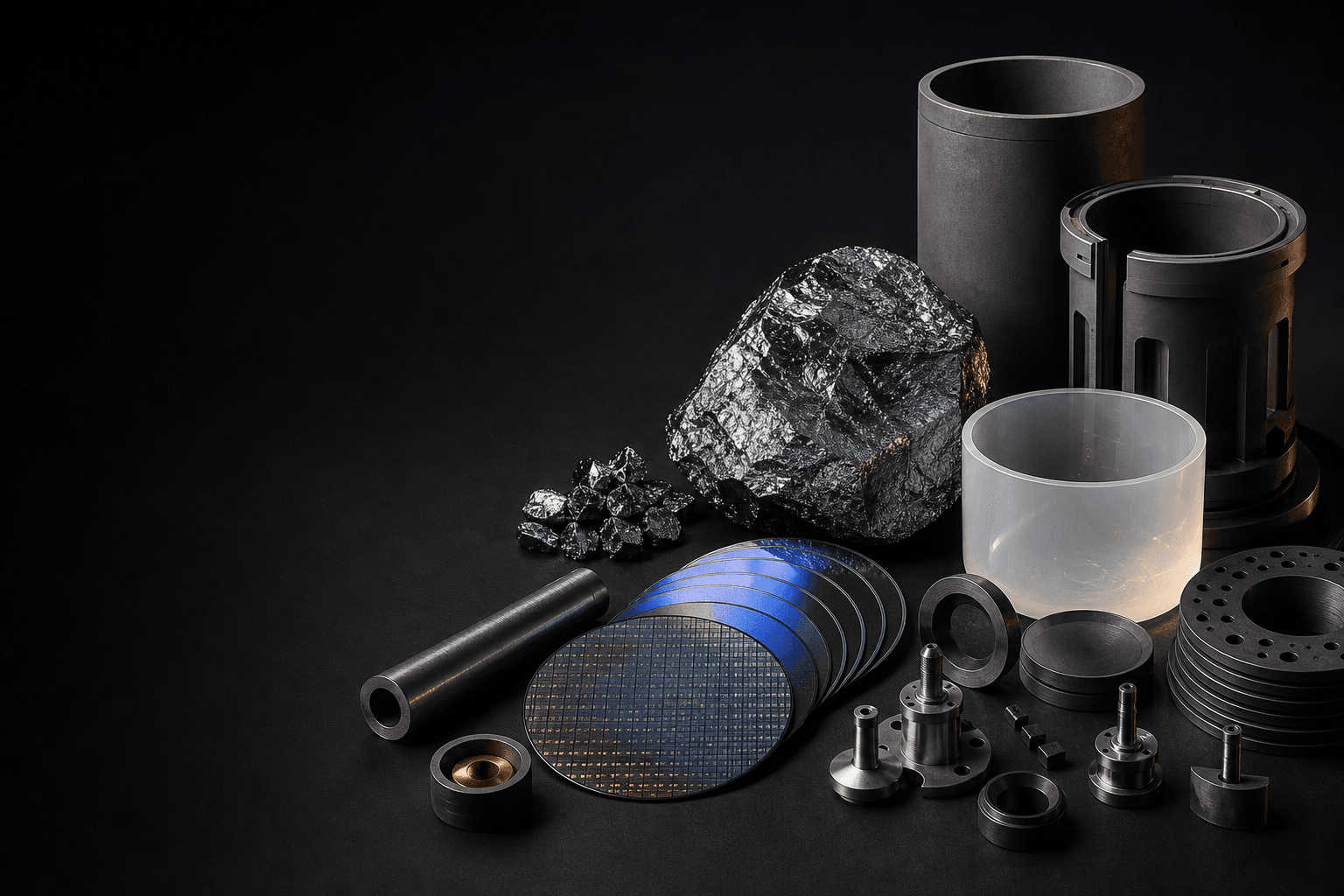
What project owners need to know.
High-purity quartz (HPQ) is natural quartz refined to less than 100 parts per million (ppm) of total impurities, about 99.99% pure, and ultra-high-purity grades go below 10 ppm (99.999%), according to the US Geological Survey. Its most strategic use is the fused-quartz crucible that holds molten silicon while Czochralski pullers grow the ingots later sliced into solar and semiconductor wafers. Because the crucible touches the melt, quartz purity flows straight into ingot quality. World supply of the highest grades is concentrated in very few deposits, which makes HPQ a supply-chain question for every country building ingot capacity, India included.
What makes quartz 'high-purity'
Ordinary quartz sand is mostly silicon dioxide, but it carries traces of other elements locked inside or around the crystal. The US Geological Survey's Mineral Commodity Summaries 2026 defines ground HPQ as natural quartz with less than 100 ppm of total impurities, equivalent to 99.99% purity, and notes that some ultra-high-purity products contain less than 10 ppm (99.999%).
Total purity is only half the specification. USGS adds that HPQ is further defined by limits on specific trace elements, and those limits depend on the end use. In practice, two lots with the same headline purity can behave differently in a furnace if their profile of particular elements differs. That is why serious buyers ask for an element-by-element certificate rather than a single percentage.
- HPQ: below 100 ppm total impurities (about 99.99% SiO2), per USGS
- Ultra-high-purity quartz (UHPQ): below 10 ppm (about 99.999%), per USGS
- Specific trace-element limits are set by the application, not by one universal grade
Why the crucible is where purity matters most
USGS lists HPQ end uses as electronics, fibre-optic cables, high-temperature lamp tubing, specialty glass and fused quartz crucibles for silicon ingots that are later processed into wafers for the photovoltaic and semiconductor markets. The crucible is the use closest to JRST's world.
In Czochralski growth, polysilicon is melted inside a quartz crucible and a single crystal is pulled from the melt. The crucible lining is in direct contact with molten silicon for the whole run, so whatever the quartz carries can end up in the melt and, from there, in the crystal. Grist's reporting on the solar supply chain notes that crucible purity affects both ingot yields and crucible lifespan. The crucible is also a consumable, which means quartz demand scales with the number of ingots pulled, not just with the number of furnaces installed.
USGS says growing global manufacture of silicon ingots has raised demand for HPQ used in fused quartz crucibles in recent years, while noting a dip in photovoltaic-driven demand in 2024 continuing into 2025.
Crucible-grade HPQ is not the same as industrial quartz
Quartz grit and powder for glass, engineered stone or foundry use are valuable products, but they are a different market from crucible-grade sand. The difference is not only the purity number; it is the trace-element control, the consistency from lot to lot and the testing regime behind each delivery.
USGS describes the route at the main US source: pegmatite rock is crushed, washed, scrubbed and sorted, then the HPQ fraction goes through further physical, chemical and thermal processing. Each step removes a different kind of contamination, and the sequence has to be tuned to the specific ore body. That is why HPQ capability is built plant by plant, not bought off a shelf.
- Ask for element-by-element impurity data, not just a headline purity
- Ask how lot-to-lot consistency is controlled and certified
- Match the grade to the end use: crucible, fused quartz, lamp tubing or specialty glass
Why world supply is so concentrated
USGS says global HPQ reserves are estimated to be limited to a few locations. It names the United States as the estimated production leader, with other sources in Australia, Brazil, Canada, China, India and Russia, and reports that in 2025 two companies produced HPQ around Spruce Pine, North Carolina. USGS also states that no economic substitutes for HPQ exist for most applications.
Estimates of Spruce Pine's share vary and should be read as estimates. Grist, citing BloombergNEF, reported in October 2024 that the district supplies more than 80% of the ultra-pure quartz sand used to make crucibles for the solar and semiconductor industries. When Hurricane Helene struck the area in September 2024, mining and processing were halted, and the episode became a widely cited example of single-point-of-failure risk in the silicon chain.
New sources are being explored. USGS reports that China's Ministry of Natural Resources announced more than 35 million tons of HPQ reserves in Henan and Xinjiang in April 2025, with initial tests at 99.995% to 99.998% purity, against greater than 99.999% for Spruce Pine material. That gap is a reminder that a new deposit is a starting point, and qualifying it for crucibles takes processing and time.
What this means for India
India is building ingot and wafer capacity ahead of ALMM List-III, which MNRE has announced for ingots and wafers from 1 June 2028. Every Czochralski puller in those plants will consume quartz crucibles, so crucible-grade quartz is an upstream dependency that sits even before polysilicon in the planning order.
USGS lists India among the countries that are sources of HPQ, which makes domestic processing capability a realistic goal rather than a slogan. The practical work is in beneficiation and qualification: proving that a domestic lot meets the trace-element limits a crucible maker, and in turn an ingot maker, will accept.
Buyers planning ingot lines should treat quartz the same way they treat polysilicon: name the grade and test method in the contract, ask for consistency data, and plan qualification runs before volume orders.
- Map crucible consumption into the ingot plant's materials plan early
- Specify trace-element limits and test methods, not just a purity percentage
- Plan qualification runs for any new quartz or crucible source
- Track ALMM List-III timing alongside upstream material readiness
How JRST supports this requirement
JRST's team delivered Pondicherry's first high-purity quartz-sand plant on a turnkey basis and holds a stake in it, and can support quartz-sand plant planning, crucible and consumable sourcing, and the link from quartz to crucible to ingot for Indian silicon projects. Grades, specifications and qualification results are project-specific and must be validated by testing.
Discuss your requirement
Mohammed Saif Zaveri connects JRST's industrial content to execution conversations.
As Co-Founder and designated partner of JRST Technology LLP, Mohammed Saif Zaveri works across industrial growth, strategic partnerships, client conversations, equipment strategy, and project pathways for silicon, solar, semiconductor, and advanced-manufacturing opportunities.
This knowledge page is part of JRST's public industrial knowledge base, designed to help buyers move from search terms and early research toward a structured technical-commercial discussion.
View Mohammed Saif Zaveri's profileConnect on LinkedInFrequently asked questions
What is high-purity quartz (HPQ)?
HPQ is natural quartz refined to less than 100 ppm of total impurities, equivalent to about 99.99% purity, according to the US Geological Survey. Ultra-high-purity grades contain less than 10 ppm (99.999%).
What is high-purity quartz sand used for?
USGS lists electronics, fibre-optic cables, fused quartz crucibles for silicon ingots, high-temperature lamp tubing and specialty glass. For solar and semiconductors, the crucible that holds molten silicon during Czochralski growth is the key use.
What is the difference between HPQ and UHPQ?
The difference is impurity level. HPQ is below 100 ppm total impurities; ultra-high-purity quartz (UHPQ) is below 10 ppm. Beyond total purity, each application sets its own limits on specific trace elements.
Where does most high-purity quartz come from?
USGS says HPQ reserves are limited to a few locations, with the United States the estimated production leader and other sources in Australia, Brazil, Canada, China, India and Russia. BloombergNEF, as reported by Grist in 2024, estimated that the Spruce Pine district in North Carolina supplies more than 80% of the ultra-pure quartz sand used for solar and semiconductor crucibles. Estimates vary between sources.
Why does quartz purity matter for silicon ingots?
The crucible lining touches molten silicon for the whole growth run, so impurities in the quartz can transfer into the melt and the crystal. Crucible purity also affects ingot yield and crucible life.
Is HPQ the same as ordinary silica sand?
No. Industrial quartz for glass or engineered stone and crucible-grade HPQ are different products. Crucible-grade material needs tight trace-element control, lot-to-lot consistency and certified testing, achieved through additional physical, chemical and thermal processing.
Does India produce high-purity quartz?
USGS lists India among the countries that are sources of HPQ. JRST's team delivered Pondicherry's first high-purity quartz-sand plant on a turnkey basis and holds a stake in it. Availability of specific grades should be confirmed with suppliers and verified by testing.
Primary sources and further reading
Last reviewed 2026-10-12. Technical scope, policy eligibility, availability, and commercial terms should be independently confirmed for each project.