
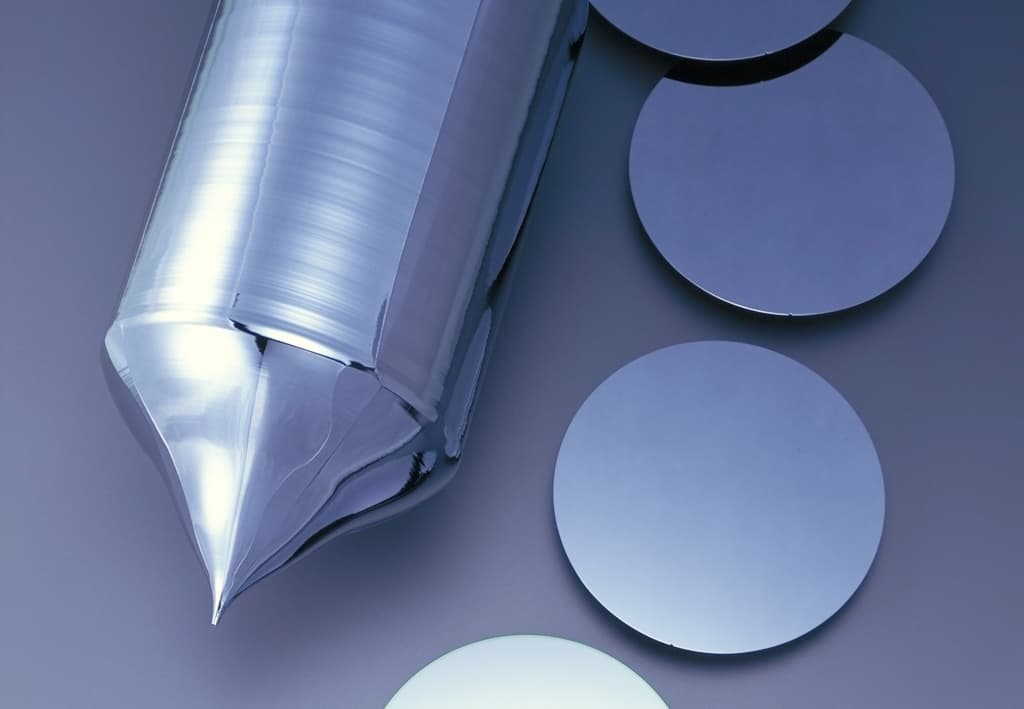
What project owners need to know.
Metallurgical-grade silicon (MG-Si), sold commercially as silicon metal, is silicon of roughly 98–99% purity made by reducing quartz with carbon in an electric arc furnace. It is the raw material for aluminium alloys and silicones, and the starting point that the Siemens process refines into solar- and electronic-grade polysilicon. USGS lists no silicon-metal output for India, and trade data show India importing most of what it uses, largely from China.
Where the silicon in a wafer really starts
Every solar wafer traces back to quartz. Before silicon can be purified into polysilicon, grown into an ingot and sliced, it has to be freed from oxygen. That first step produces metallurgical-grade silicon, usually shortened to MG-Si and traded as silicon metal.
It is an industrial commodity, not an electronic material. PVEducation describes MG-Si as about 98% pure, with a wider range of 98–99%, and used extensively in the metallurgical industry. Our Siemens-process guide covers what happens next; this guide covers the step before it.
- Quartz → MG-Si (this guide)
- MG-Si → polysilicon (Siemens or FBR route)
- Polysilicon → ingot → wafer → cell → module
How it is made: quartz, carbon and an arc furnace
MG-Si is made by carbothermic reduction: silica, in the form of quartz or quartzite, is reduced with carbon in an electric arc furnace using carbon electrodes. PVEducation gives the furnace range as 1,500–2,000 °C and names coal and charcoal as reducing agents; a silicon metal supplier, Westbrook Resources, puts the main reaction zone above 1,800 °C.
The simplified reaction is silica plus carbon giving silicon and an oxide of carbon. In practice the furnace is a continuous, power-hungry smelter, and the quality of what comes out depends heavily on what goes in. PVEducation notes that impurity levels vary widely with process variation and with the silica and carbon raw materials used.
- Feed: quartz or quartzite plus carbon reductants (coal, charcoal)
- Furnace: electric arc, carbon electrodes, reaction zone above ~1,800 °C
- Output: liquid silicon tapped and cast, then crushed and sized
What the grade codes 553, 441 and 3303 mean
Silicon metal is usually sold by a short code that lists maximum impurities in a fixed order: iron, aluminium and calcium. Westbrook Resources gives 553 as at most 0.5% iron, 0.5% aluminium and 0.3% calcium; 441 as 0.4%, 0.4% and 0.1%; 3303 as 0.3%, 0.3% and 0.03%; and 2202 as the cleanest common grade at 0.2%, 0.2% and 0.02%.
These codes describe metallurgical cleanliness, not electronic purity. Even the cleanest grade carries far too much boron and phosphorus for a wafer. PVEducation puts boron and phosphorus in MG-Si at hundreds of parts per million by weight, which is why chemical purification through polysilicon is unavoidable for solar and chip use.
- 553: Fe ≤ 0.5%, Al ≤ 0.5%, Ca ≤ 0.3%
- 441: Fe ≤ 0.4%, Al ≤ 0.4%, Ca ≤ 0.1%
- 3303: Fe ≤ 0.3%, Al ≤ 0.3%, Ca ≤ 0.03%
- 2202: Fe ≤ 0.2%, Al ≤ 0.2%, Ca ≤ 0.02%
Solar is only one of its customers
Most silicon metal never goes near a solar panel. USGS describes the main consumers as aluminium alloy producers and the chemical industry, especially silicones, with a share further processed into semiconductor- or solar-grade polysilicon. Westbrook Resources describes aluminium alloying, for example lighter automotive parts, as the main application.
This matters for anyone planning polysilicon. A domestic polysilicon plant would compete with aluminium and silicone makers for the same feedstock, and polysilicon producers usually specify tighter impurity limits than the standard commercial grades. In the United States, silicon was added to the federal list of critical minerals in November 2025, according to USGS, a sign that the commodity is being treated as strategic rather than routine.
- Aluminium alloys: largest single use
- Chemicals: silicones and other silicon compounds
- Polysilicon: for solar and semiconductors
Global supply is concentrated
USGS's February 2026 Mineral Commodity Summary estimates that China accounted for almost 80% of global production of silicon materials in 2025, and lists China's silicon metal output at about 4.0 million tonnes for that year. Brazil, Norway, France and Australia follow at much smaller volumes.
The same summary reports that US silicon metal prices fell sharply in 2025, which it attributes to oversupply, weak aluminium and silicon demand and available polysilicon stocks. In short, the commodity is plentiful but geographically concentrated, the same pattern seen further down the solar chain.
What this means for India
In USGS's world production table, India appears as a ferrosilicon producer, at about 59,000 tonnes in 2024 and 2025, but no silicon-metal output is listed for it. Trade data point the same way: BigMint reported in September 2024 that India imported 45,665 tonnes of silicon metal in the first half of 2024, up 14% on a year earlier, with China supplying about 90%, mainly for aluminium alloy makers.
That gap sits directly under India's polysilicon plans. PV Tech reported that on 7 August 2026, MNRE Secretary Santosh Kumar Sarangi said a polysilicon PLI scheme being designed could cover more than 10 GW of capacity, with the incentive size not disclosed. A polysilicon plant fed by imported silicon metal would still carry an upstream dependency. For ingot and wafer makers preparing for ALMM List-III, the practical step is traceability: ask polysilicon suppliers to document the origin of their feedstock as well as its purity.
- India: ferrosilicon producer, no silicon-metal output listed by USGS
- Silicon metal imports: 45,665 t in H1 2024, ~90% from China (BigMint)
- Polysilicon PLI: being designed, >10 GW, outlay undisclosed (Aug 2026)
How JRST supports this requirement
JRST works on India's upstream silicon chain, from high-purity quartz and crucibles to ingot growth and wafering, and helped deliver Maharashtra's first silicon-ingot pilot. This guide describes the generic, publicly documented route from quartz to metallurgical-grade silicon for awareness only. It is not a design basis or an economic assessment: any smelting or polysilicon project's process, energy and supply figures must be validated with qualified engineers and current trade data.
Discuss your requirement
Mohammed Saif Zaveri connects JRST's industrial content to execution conversations.
As Co-Founder and designated partner of JRST Technology LLP, Mohammed Saif Zaveri works across industrial growth, strategic partnerships, client conversations, equipment strategy, and project pathways for silicon, solar, semiconductor, and advanced-manufacturing opportunities.
This knowledge page is part of JRST's public industrial knowledge base, designed to help buyers move from search terms and early research toward a structured technical-commercial discussion.
View Mohammed Saif Zaveri's profileConnect on LinkedInFrequently asked questions
What is metallurgical-grade silicon?
Metallurgical-grade silicon (MG-Si), also called silicon metal, is silicon of roughly 98–99% purity made by reducing quartz with carbon in an electric arc furnace. It is used for aluminium alloys and silicones and is the raw material for polysilicon.
How is silicon metal made from quartz?
Quartz or quartzite is smelted with carbon reductants such as coal and charcoal in an electric arc furnace with carbon electrodes. In the hottest zone, above about 1,800 °C, the carbon strips oxygen from the silica and liquid silicon is tapped off.
What do silicon metal grades 553, 441 and 3303 mean?
The digits give the maximum iron, aluminium and calcium content in that order. Grade 553 allows up to 0.5% iron, 0.5% aluminium and 0.3% calcium; 441 allows 0.4%, 0.4% and 0.1%; 3303 allows 0.3%, 0.3% and 0.03%.
What is the difference between metallurgical-grade silicon and polysilicon?
MG-Si is about 98–99% pure and still carries metals and hundreds of ppm of boron and phosphorus. Polysilicon is made from MG-Si by chemical purification, usually the Siemens process, and is many orders of magnitude purer, which is what solar and chip wafers need.
Does India produce silicon metal?
USGS lists India as a ferrosilicon producer but shows no silicon-metal output for it, and trade data show India importing most of its silicon metal, about 90% of it from China in the first half of 2024.
Which country produces the most silicon metal?
China. USGS estimates China accounted for almost 80% of global silicon-materials production in 2025, with about 4.0 million tonnes of silicon metal.
Is silicon metal the same as ferrosilicon?
No. Ferrosilicon is an iron-silicon alloy, typically 50% or 75% silicon, used mainly in steelmaking and foundries. Silicon metal is mostly silicon and is used for aluminium alloys, silicones and polysilicon.
How can JRST help?
JRST does not make silicon metal or polysilicon. It works downstream, on ingot growth, crucibles, hot zones and wafering, and helps buyers frame feedstock grade, form and origin requirements for their crystal growers.
Primary sources and further reading
Last reviewed 2026-10-14. Technical scope, policy eligibility, availability, and commercial terms should be independently confirmed for each project.