
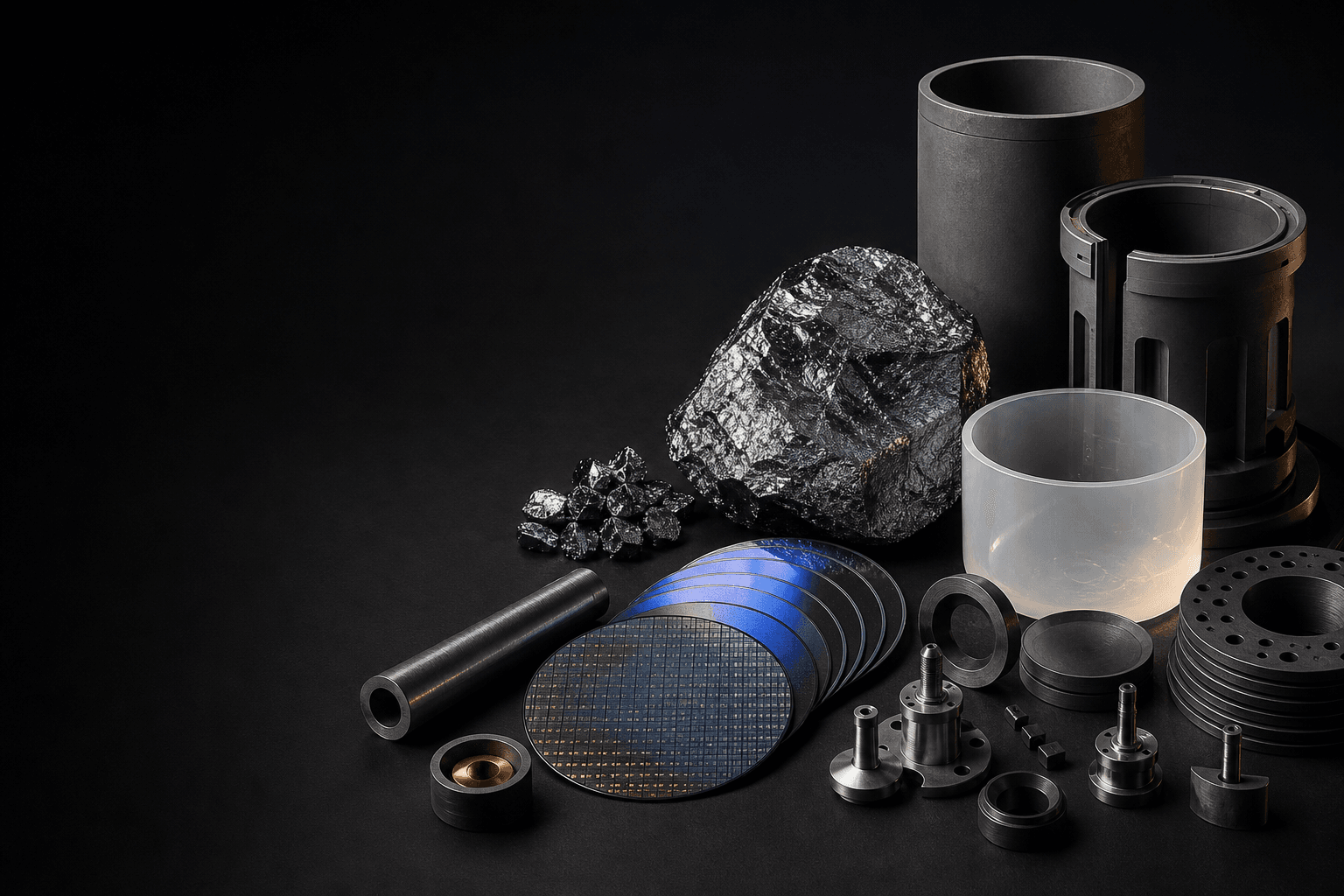
What project owners need to know.
Silica is silicon dioxide (SiO2), the compound that makes up quartz and most sand. Silicon is the element (Si), obtained by reducing silica with carbon and refined into polysilicon, ingots and solar or chip wafers. Silicone is a different, man-made polymer with a silicon-oxygen backbone and organic groups attached, used in sealants, adhesives and rubber. Solar wafers are made of silicon, which starts as silica; silicone is a separate product made from silicon.
Silica: quartz and sand
Silica is silicon dioxide, SiO2, a compound of silicon and oxygen. In nature it is found mostly as quartz, and it makes up the bulk of ordinary sand. It is hard, chemically stable and does not conduct electricity, which is why it is used in glass, ceramics and construction.
Not all silica is equal. Construction sand, glass sand and high-purity quartz differ in how much iron, aluminium, titanium and other elements they carry. The highest grades, high-purity quartz sand, are what quartz crucibles for silicon crystal growth are made from.
- Formula: SiO2
- Forms: quartz, quartzite, sand
- Uses: glass, ceramics, construction, high-purity grades for crucibles
Silicon: the element, from silica to wafer
Silicon is the chemical element Si. It is never found free in nature; it has to be separated from the oxygen in silica. Industrially that is done by smelting quartz or quartzite with carbon in an electric arc furnace, which produces metallurgical-grade silicon, traded as silicon metal.
USGS describes the main users of silicon metal as aluminium alloy makers and the chemical industry, especially for silicones, with a share refined further into the ultra-high-purity grades called polysilicon. Polysilicon is melted in a quartz crucible and grown into a monocrystalline ingot by the Czochralski method, then sliced into the wafers that become solar cells and chips.
- Quartz → metallurgical-grade silicon (arc furnace)
- Metallurgical-grade silicon → polysilicon (chemical purification)
- Polysilicon → ingot → wafer → solar cell or chip
Silicone: a polymer, not a semiconductor
Silicone, also called polysiloxane, is a man-made polymer. Its backbone is a repeating chain of silicon and oxygen atoms, with organic groups such as methyl attached to the silicon. Depending on its formulation it can be an oil, a gel or a rubbery solid.
Silicones are used in sealants, adhesives, lubricants, medical products, cookware and electrical insulation. They are made from silicon metal through chemical processing, which is why the chemical industry is one of silicon metal's main customers. Silicone is not used to make wafers and is not a semiconductor material, though silicone sealants and encapsulants do appear in finished solar modules.
- Made from silicon metal, not dug from the ground
- Used for sealing, bonding, insulation and lubrication
- In solar: sealants and potting in modules and junction boxes, not in the wafer
Where the three meet in the solar chain
The three words describe three stages of the same material story. Silica, as high-purity quartz, gives both the silicon itself and the crucible the silicon is grown in. Silicon, refined to polysilicon, becomes the ingot and wafer. Silicone, made from silicon metal, turns up again at the very end as a sealant in the finished module.
Keeping them apart matters in procurement and policy. A 'silica' supplier, a 'silicon' supplier and a 'silicone' supplier serve entirely different markets, and only the first two sit on the path from quartz to wafer.
- High-purity quartz (silica) → crucible and silicon feedstock
- Silicon → polysilicon → ingot → wafer → cell
- Silicone → module sealants and adhesives
How JRST supports this requirement
JRST works on the silica-to-silicon side of this story, not silicone: high-purity quartz sand from its Pondicherry plant, quartz crucibles and consumables for crystal growth, and Maharashtra's first silicon-ingot line in Nagpur. This explainer describes widely documented chemistry and industry usage for awareness; material grades and specifications for any project should be confirmed by testing and with qualified suppliers.
Discuss your requirement
Mohammed Saif Zaveri connects JRST's industrial content to execution conversations.
As Co-Founder and designated partner of JRST Technology LLP, Mohammed Saif Zaveri works across industrial growth, strategic partnerships, client conversations, equipment strategy, and project pathways for silicon, solar, semiconductor, and advanced-manufacturing opportunities.
This knowledge page is part of JRST's public industrial knowledge base, designed to help buyers move from search terms and early research toward a structured technical-commercial discussion.
View Mohammed Saif Zaveri's profileConnect on LinkedInFrequently asked questions
What is the difference between silicon, silicone and silica?
Silica is silicon dioxide (SiO2), found in quartz and sand. Silicon is the element (Si) obtained by reducing silica; it is refined into polysilicon, ingots and solar wafers. Silicone is a different, man-made polymer with a silicon-oxygen backbone and organic groups, used in sealants and rubber.
Is sand silicon?
Not directly. Most sand is largely silica, silicon dioxide. Silicon has to be extracted from silica by smelting it with carbon, and only high-purity quartz, not ordinary sand, is suitable for the most demanding uses such as crucibles for silicon crystal growth.
Is quartz the same as silica?
Quartz is the most common crystalline form of silica (silicon dioxide). All quartz is silica, but silica also occurs in other forms, including amorphous fused silica made by melting quartz.
Are solar panels made of silicone?
The cells are made of silicon, not silicone. Silicone does appear in many modules as a sealant or potting compound, for example around the frame and junction box.
Is silicone made from silicon?
Yes. Silicones are produced from silicon metal by chemical processing, and USGS lists the chemical industry, particularly silicones, among silicon metal's main consumers.
Primary sources and further reading
Last reviewed 2026-10-24. Technical scope, policy eligibility, availability, and commercial terms should be independently confirmed for each project.