
What project owners need to know.
Quartzite and smelting-grade lump quartz are the silicon source fed into arc furnaces to make silicon metal, while high-purity quartz (HPQ) is quartz refined to below 100 ppm of total impurities and fused into the crucibles that hold molten silicon during ingot growth. Both are silicon dioxide, but furnace quartz is judged on chemistry plus lump size and how well it survives heating, and crucible quartz is judged on element-by-element trace purity. One deposit rarely suits both, so the silicon chain needs two different quartz supply lines.
Same mineral, two different jobs
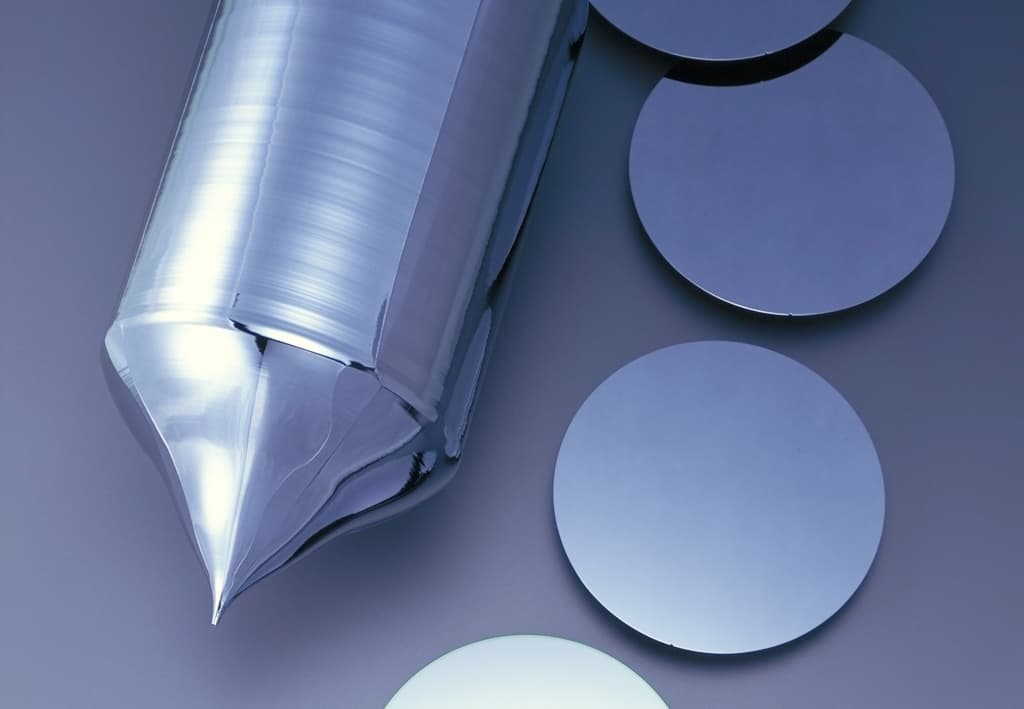
Quartz enters the solar and semiconductor chain twice. First, at the very start, lump quartz or quartzite is smelted with carbon to make metallurgical-grade silicon, the feedstock that is later refined into polysilicon. Second, much further down, high-purity quartz sand is fused into the crucible that holds that polysilicon while a crystal puller grows an ingot.
Both materials are essentially silicon dioxide, which is why they are often lumped together. The Indian Bureau of Mines (IBM) itself groups quartz, quartzite, silica sand and moulding sand under one name, silica minerals, noting that they differ mostly in crystalline structure and minor or trace impurities. For a silicon project, those differences are the whole story.
- Stream 1: lump quartz / quartzite → arc furnace → silicon metal (MG-Si)
- Stream 2: HPQ sand → fused-quartz crucible → Czochralski ingot
- Same mineral family, different specifications, usually different deposits
What a silicon furnace asks of quartz
In a submerged arc furnace, quartz is charged as lumps together with carbon materials and heated above 2,000 °C, according to a 2020 NTNU doctoral thesis on industrial quartz. The thesis names three properties that decide whether a quartz type is suitable for silicon or ferrosilicon: fines generation (together with lump size), phase transformations and impurity content.
Chemistry matters because impurities in the raw materials carry into the silicon, and PVEducation notes that impurity levels in metallurgical silicon vary with the silica and carbon used. But furnace quartz is not bought on chemistry alone. A lump that cracks into dust as it heats chokes the furnace even if it is chemically clean.
- Chemistry: high silica, low iron, aluminium, calcium and other impurities
- Lump size: matched to the furnace and to the quartz's own behaviour
- Thermal behaviour: how much the lumps crack and shed fines when heated
Thermal stability: why clean quartz can still fail
As quartz is heated it converts to other forms of silica, notably cristobalite. The NTNU thesis puts the theoretical volume increase of the quartz-to-cristobalite transformation at 17%, and explains that fines created in the furnace reduce permeability: the downward flow of raw materials and the upward flow of gases. When it shock-heated different industrial quartz types to 1,500 °C, the share of fines below 10 mm ranged from about 5% to 85% by weight.
A 2018 industrial study from Kazakhstan, published in the Oriental Journal of Chemistry, describes the traditional screening test: pieces of 20–30 mm are held at about 1,300 °C for an hour, then tumbled and sieved; heavy breakdown marks the quartz as poor for smelting. Its authors reported that poorly stable quartz raised energy use, cut silicon recovery and increased dust, and that the less thermally stable the quartz, the larger its starting lumps should be. The optimum they found differed between two deposits, roughly 85–95 mm for one and 30–40 mm for the other, and they stress that it also depends on the furnace.
- Quartz → cristobalite: ~17% theoretical volume increase (NTNU)
- Fines below 10 mm after shock heating: ~5% to ~85% depending on quartz type (NTNU)
- Less stable quartz generally needs larger lumps; the optimum is furnace-specific
What a crucible asks of quartz
The crucible is the opposite problem. Its quartz is ground to sand, purified and fused, so lump strength is irrelevant and trace chemistry is everything. USGS defines high-purity quartz as natural quartz with less than 100 ppm of total impurities, about 99.99% pure, with some ultra-high-purity products below 10 ppm, and adds that HPQ is further defined by limits on specific trace elements set by the end use.
That bar is far tighter than anything a silicon furnace needs, because the crucible lining touches molten silicon for the whole growth run. It is also why HPQ is supplied from very few deposits worldwide. Our high-purity quartz guide covers that market in detail.
- Furnace quartz: chemistry + lump size + thermal stability
- Crucible quartz: element-by-element trace purity, consistency and certified testing
- A deposit that suits one job is not automatically suitable for the other
India: plenty of silica, thin data
India is not short of silica. IBM's Indian Minerals Yearbook 2022 puts total quartz and silica sand reserves and resources at about 3,908 million tonnes, and quartzite at about 1,659 million tonnes, both as of 1 April 2015. Only part of that is graded for metallurgy: about 184 million tonnes of quartz and silica sand resources are classed as ferro-silicon grade. IBM says that in India these minerals are used mainly in glass, foundry, ferroalloys and refractories.
Production data are patchy. Since a February 2015 notification, quartz, quartzite and silica sand are minor minerals regulated by the states, so producers report to state governments rather than IBM, and IBM says it could collect data for only a few states. Meanwhile USGS lists India as a ferrosilicon producer but shows no silicon-metal output, so domestic quartz currently feeds ferroalloys rather than a silicon-metal industry.
For anyone planning India's upstream silicon chain, the practical point is that quartz has to be qualified twice. A smelter needs lump quartz tested for chemistry and thermal behaviour in its own furnace; a crucible maker needs HPQ certified element by element. Neither can be judged from a headline SiO₂ percentage.
- Quartz + silica sand resources: ~3,908 Mt; quartzite: ~1,659 Mt (IBM, as of 1.4.2015)
- Ferro-silicon grade quartz and silica sand resources: ~184 Mt (IBM)
- Minor minerals since 2015: production reported to states, national data incomplete
How JRST supports this requirement
JRST's team delivered Pondicherry's first high-purity quartz-sand plant on a turnkey basis and works across India's upstream silicon chain, from quartz and crucibles to ingot growth and wafering. This guide describes publicly documented differences between furnace quartz and crucible quartz for awareness only. Grades, lump sizes and test results are deposit- and furnace-specific and must be validated by testing with qualified engineers.
Discuss your requirement
Mohammed Saif Zaveri connects JRST's industrial content to execution conversations.
As Co-Founder and designated partner of JRST Technology LLP, Mohammed Saif Zaveri works across industrial growth, strategic partnerships, client conversations, equipment strategy, and project pathways for silicon, solar, semiconductor, and advanced-manufacturing opportunities.
This knowledge page is part of JRST's public industrial knowledge base, designed to help buyers move from search terms and early research toward a structured technical-commercial discussion.
View Mohammed Saif Zaveri's profileConnect on LinkedInFrequently asked questions
What is the difference between quartzite and high-purity quartz?
Quartzite is a metamorphic rock made almost entirely of quartz grains, and lump quartz or quartzite is used as the silicon source in arc furnaces. High-purity quartz (HPQ) is quartz refined to below 100 ppm of total impurities, used mainly for fused-quartz crucibles and electronics. They are judged on different properties and usually come from different deposits.
What kind of quartz is used to make silicon metal?
Lump quartz or quartzite with high silica and low impurities, sized to suit the furnace. Besides chemistry, smelters look at how much the lumps crack and create fines when heated, because fines reduce furnace permeability.
What is thermal stability of quartz?
It is how well quartz lumps resist breaking apart when heated. As quartz converts to cristobalite its volume rises, theoretically by about 17%, which can crack lumps into fines that disrupt a silicon furnace.
Can high-purity quartz sand be used in a silicon furnace?
Arc furnaces are charged with lumps, not fine sand, and need permeability for gases to flow. HPQ sand is also a far more refined product than smelting needs. Crucible-grade HPQ and furnace quartz are therefore different products.
Does India have quartz for silicon production?
India has large silica resources. IBM's Indian Minerals Yearbook 2022 lists about 3,908 million tonnes of quartz and silica sand and about 1,659 million tonnes of quartzite as of April 2015, including about 184 million tonnes of quartz and silica sand graded ferro-silicon. Suitability for silicon metal still has to be proven deposit by deposit.
Why is India's quartz production data incomplete?
Since February 2015, quartz, quartzite and silica sand have been minor minerals regulated by the states. Producers report to state governments rather than the Indian Bureau of Mines, which says it could collect data for only a few states.
How can JRST help?
JRST works on the quartz-to-crucible-to-ingot link and helps buyers frame what to test before committing to a quartz source. It does not mine quartz or smelt silicon metal.
Primary sources and further reading
Last reviewed 2026-10-16. Technical scope, policy eligibility, availability, and commercial terms should be independently confirmed for each project.