
What project owners need to know.
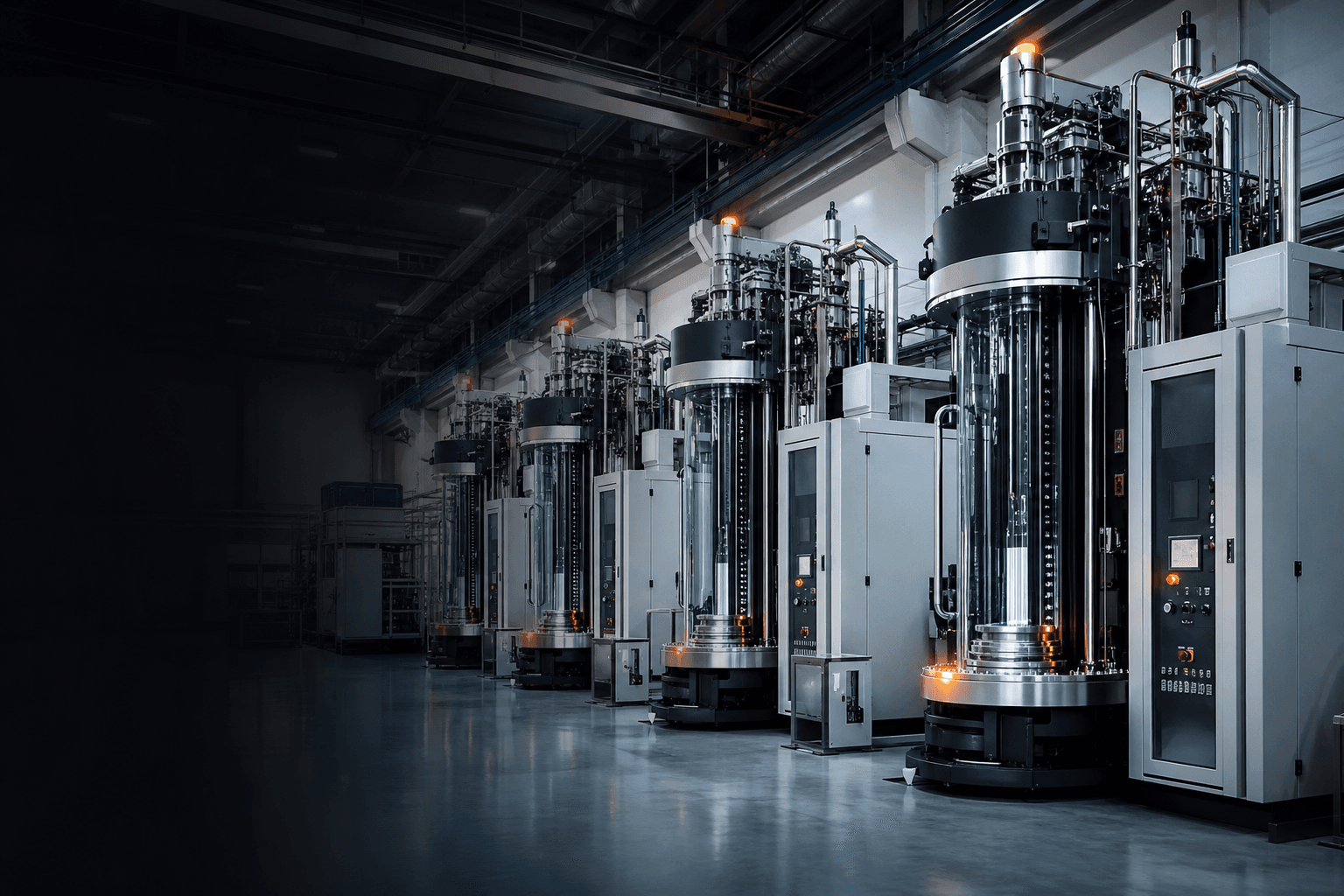
A CZ crystal puller is the furnace that grows a single-crystal silicon ingot by melting polysilicon in a quartz crucible and slowly drawing a crystal from the melt on a rotating seed. India imports most of these machines today. Domestic efforts are emerging: Hosur-based Raana Semiconductors told Mercom in 2026 that its CZ systems are about 60–70% localised, a figure the company reports itself.
What a Czochralski puller does
The Czochralski (CZ) method is how nearly all monocrystalline silicon for solar and chips is grown. Polysilicon is loaded into a fused-quartz crucible and melted under argon. A small seed crystal is dipped into the melt and slowly pulled upward while seed and crucible rotate, and the silicon freezes onto the seed in the same crystal orientation, producing a cylindrical ingot.
The puller is the machine that does this: a vacuum-tight furnace chamber, a heated crucible assembly, a pulling and rotation mechanism above it, and the controls that hold temperature, speed and gas flow steady over a run lasting many hours.
The subsystems that decide ingot quality
Buyers often compare pullers on price and nameplate size. The variables that matter for yield sit in a handful of subsystems.
- Hot zone: graphite heaters, insulation and heat shields that shape the temperature field
- Crucible system: quartz crucible inside a graphite susceptor, with lift and rotation
- Seed lift and rotation: sets pull speed and diameter control
- Argon and vacuum: flow and pressure carry away oxides and limit contamination
- Controls and sensing: diameter cameras, temperature loops, recipe management
- Recharge capability: whether more polysilicon can be fed without cooling down
Why equipment matters as much as feedstock
Good polysilicon can still make a poor ingot. The puller sets the thermal gradient at the growth interface, which affects dislocation-free growth, and the gas and crucible conditions influence how much oxygen ends up in the crystal. Oxygen and defects later show up as lifetime and efficiency losses in the cell.
That is why hot-zone design, crucible quality and argon management are linked decisions. A puller specified without its consumables plan is only half specified.
India's equipment position
Most crystal pullers in Indian ingot projects are imported. Domestic manufacturing is at an early stage. In an interview published by Mercom in August 2026, Raana Semiconductors said a CZ system has more than 300 components, that it began localising about a decade ago at 30–40% Indian content, and that it has reached about 60–70%, with a target of about 10% imports in three to four years. These are the company's own figures.
The company also described a 100 MW pilot ingot plant near Bengaluru and said Indian equipment is currently priced about 15–20% above comparable Chinese systems, asking for government support and patient capital. PV Tech reported in September 2026 that Raana plans to launch a commercial 12-inch CZ machine within 10 to 12 months. Raana raised $3 million in seed funding in January 2026, Mercom reported.
- Today: imported equipment dominates
- Emerging: domestic CZ systems, partly localised (self-reported)
- Open questions: service network, spares depth, track record at GW scale
A sourcing checklist for crystal pullers
These checks apply whether the machine is imported, domestic, new or refurbished. Ask for documents, not brochures.
- Ingot diameter and crucible size matched to your wafer format
- Demonstrated output per puller on a comparable recipe, with test data
- Hot-zone design and the cost and lead time of replacement parts
- Crucible specification and approved crucible suppliers
- Argon consumption and recovery options
- Recharge or continuous-feed capability
- Local service engineers, spares stock and response times
- Operator and process-engineer training included in scope
- Acceptance criteria written into the purchase contract
Equipment, crucibles and quartz are one decision
Every CZ run consumes a quartz crucible, and crucible quality affects oxygen, contamination and run length. Crucibles are made from high-purity quartz sand, a material with concentrated global supply. A puller order should therefore come with a crucible plan and, ideally, a view on where the crucible-grade quartz comes from.
How JRST supports this requirement
JRST sources MCG and CZ crystal-growth equipment, consumables and spares for ingot projects and set up Maharashtra's first silicon-ingot line in Nagpur. We help buyers write puller specifications and acceptance criteria. This guide summarises public industry reporting as of the date shown; company figures are self-reported and attributed. Validate equipment performance against supplier test data and your own recipe before making a procurement decision.
Discuss your requirement
Mohammed Saif Zaveri connects JRST's industrial content to execution conversations.
As Co-Founder and designated partner of JRST Technology LLP, Mohammed Saif Zaveri works across industrial growth, strategic partnerships, client conversations, equipment strategy, and project pathways for silicon, solar, semiconductor, and advanced-manufacturing opportunities.
This knowledge page is part of JRST's public industrial knowledge base, designed to help buyers move from search terms and early research toward a structured technical-commercial discussion.
View Mohammed Saif Zaveri's profileConnect on LinkedInFrequently asked questions
What is a crystal puller?
A crystal puller is a furnace that grows a single-crystal silicon ingot by the Czochralski method: polysilicon is melted in a quartz crucible under argon and a rotating seed crystal is slowly drawn upward, so the silicon solidifies as one large crystal.
Does India make CZ crystal pullers?
Domestic manufacturing is emerging but small. Hosur-based Raana Semiconductors told Mercom in 2026 that its CZ systems are about 60–70% localised, and PV Tech reported plans for a commercial 12-inch machine. Most pullers in Indian projects are still imported.
What consumables does a crystal puller need?
Mainly quartz crucibles, graphite hot-zone parts such as heaters, susceptors and insulation, argon gas, and seed crystals. Crucibles are replaced every run or campaign, so they are a recurring cost.
How long does it take to grow a solar ingot?
It depends on ingot length, diameter, recipe and whether the puller recharges between pulls. We do not publish a universal figure; ask suppliers for run data on a recipe comparable to yours.
What should I check before buying an ingot furnace?
Diameter fit, demonstrated output, hot-zone parts cost, crucible specification, argon use, recharge capability, local service and spares, training, and written acceptance criteria.
Primary sources and further reading
Last reviewed 2026-10-16. Technical scope, policy eligibility, availability, and commercial terms should be independently confirmed for each project.