
What project owners need to know.
A blue wafer is a silicon wafer that has already been diffused (doped to form the cell junction) abroad; a black wafer is an undiffused wafer that has not. In March 2025 MNRE clarified that solar cells made from imported blue wafers do not qualify as domestically manufactured under DCR; only cells made in India from undiffused black wafers, classifiable under Customs Tariff Head 3818, with every later step done in India, qualify.
What makes a wafer blue or black
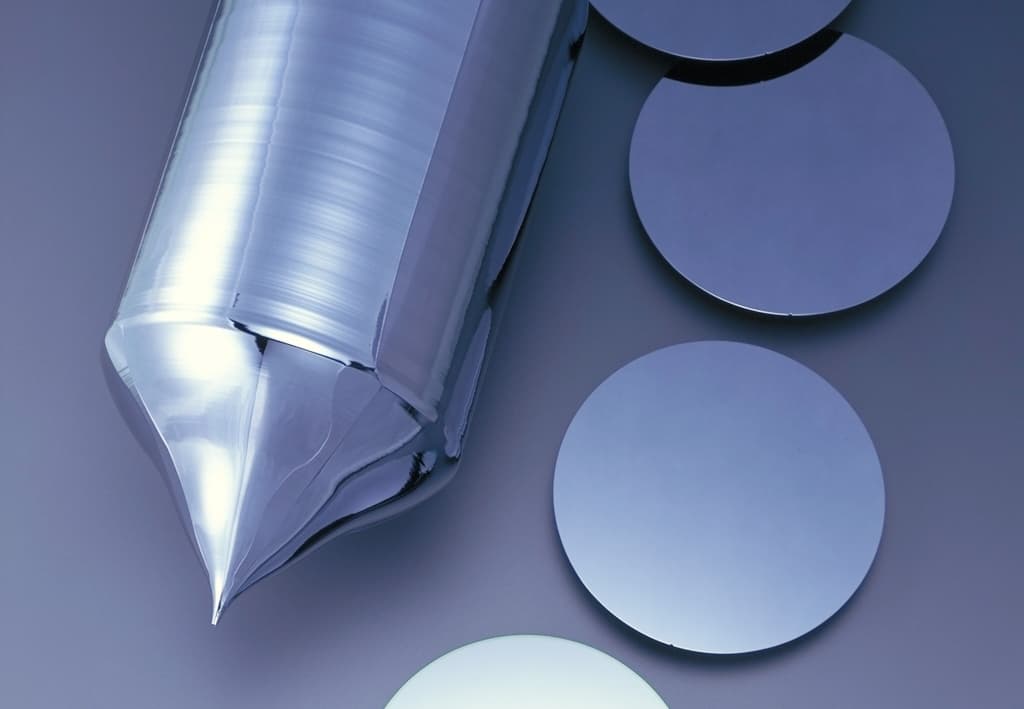
A silicon wafer comes off the wire saw as a bare, grey-black slice of a crystalline ingot. To become a solar cell it is textured, then diffused: a dopant such as phosphorus or boron is driven into the surface to form the p-n junction. Later steps add passivation, an anti-reflection coating and metal contacts.
In Indian trade and policy usage, a wafer that has already been through diffusion abroad is called a blue wafer, and an undiffused wafer is called a black wafer. The distinction matters because diffusion is where a wafer starts to become a cell, so it marks where 'cell manufacturing' begins.
- Black wafer: sliced and cleaned, not yet diffused
- Blue wafer: diffused abroad, partway to a finished cell
- Cell: completed in a cell line after diffusion, passivation and metallisation
What MNRE clarified in March 2025
pv magazine India reported on 11 March 2025 that MNRE had clarified that solar cells made from imported diffused silicon wafers, generally called blue wafers, shall not qualify as domestically manufactured for schemes that require domestic cells. A crystalline-silicon cell counts as domestic only if it is made in India from an undiffused black wafer classifiable under Customs Tariff Head 3818, with all subsequent steps carried out in India.
The same clarification reiterated that thin-film modules made in an integrated factory in India remain eligible. The schemes named in reporting as requiring DCR modules include PM Surya Ghar Muft Bijli Yojana, PM-KUSUM and CPSU Phase II. The exact wording should be read in MNRE's own order before it is relied on for a bid.
- Imported blue wafer → cell made in India: not domestic for DCR
- Imported black wafer (CTH 3818) → all steps in India: domestic cell
- Thin-film modules from an integrated Indian factory: eligible
Why customs heading 3818 matters
Customs Tariff Head 3818 covers chemical elements doped for use in electronics, in the form of discs, wafers or similar forms. Tying DCR eligibility to a wafer imported or produced under this heading gives a checkable test: the wafer must arrive as a wafer, not as a part-processed cell.
For buyers this is a documentation question as much as a technical one. Import records, bills of entry and process records at the cell line are what show that a cell started from an undiffused wafer. Our guide to silicon ingot and wafer HS codes covers how 2804 and 3818 are used.
How it links to ALMM List-II, the cell code and List-III
ALMM List-II, MNRE's approved list for solar cells, took effect on 1 June 2026. MNRE's October 2026 draft nomenclature for List-II cells goes further: PV Tech reported that its first four characters would flag whether the polysilicon, ingot, wafer and cell are domestic or foreign, and that cells made from blue or diffused wafers would not count as domestic.
The next step upstream is ALMM List-III for ingots and wafers, scheduled for 1 June 2028. The blue-wafer rule, the proposed cell code and List-III all point the same way: Indian policy is moving the definition of 'domestic' steadily up the chain, from module to cell to wafer and ingot.
- DCR: blue-wafer cells excluded since March 2025
- ALMM List-II: cells, from 1 June 2026
- Proposed cell code: origin flags for polysilicon, ingot, wafer and cell
- ALMM List-III: ingots and wafers, scheduled from 1 June 2028
Why it raises the value of domestic ingot and wafer capacity
Excluding blue wafers closes one route by which imported, part-processed material could be counted as domestic. It does not yet require an Indian wafer: a cell made in India from an imported black wafer still qualifies for DCR today. That changes as List-III takes effect and as origin becomes visible in the cell code.
For the ingot and wafer stage, which in India depends on Czochralski pullers, high-purity quartz crucibles, polysilicon and diamond-wire slicing, the direction of policy is clear even where timelines are still being finalised. Projects that plan their materials and equipment now are better placed when the requirement reaches the wafer.
How JRST supports this requirement
JRST works on the stage this rule is pushing India towards: Maharashtra's first silicon-ingot line in Nagpur, high-purity quartz sand from its Pondicherry plant, and the crucibles and consumables ingot growth depends on. We help cell and module teams plan the move from imported wafers to traceable domestic supply. This guide summarises public reporting on MNRE's clarification as of the date shown and is not legal advice; confirm the exact wording of the MNRE order and the rules of any scheme before making a sourcing or bidding decision.
Discuss your requirement
Mohammed Saif Zaveri connects JRST's industrial content to execution conversations.
As Co-Founder and designated partner of JRST Technology LLP, Mohammed Saif Zaveri works across industrial growth, strategic partnerships, client conversations, equipment strategy, and project pathways for silicon, solar, semiconductor, and advanced-manufacturing opportunities.
This knowledge page is part of JRST's public industrial knowledge base, designed to help buyers move from search terms and early research toward a structured technical-commercial discussion.
View Mohammed Saif Zaveri's profileConnect on LinkedInFrequently asked questions
What is a blue wafer?
A blue wafer is a silicon wafer that has already been diffused, meaning a dopant has been driven in to form the cell junction, typically abroad. It is part of the way to being a finished solar cell.
What is a black wafer?
A black wafer is an undiffused silicon wafer: sliced from an ingot and cleaned, but not yet processed into a cell. Under MNRE's March 2025 clarification, DCR cells must start from undiffused wafers classifiable under Customs Tariff Head 3818.
Do cells made from blue wafers qualify as DCR in India?
No. MNRE clarified in March 2025 that solar cells made from imported diffused (blue) wafers do not qualify as domestically manufactured. Cells qualify only if made in India from undiffused (black) wafers, with all later steps in India.
What is Customs Tariff Head 3818?
It is the customs heading for chemical elements doped for use in electronics, in the form of discs, wafers or similar forms. MNRE's clarification uses it to identify the undiffused wafers from which a domestic cell must be made.
Does the blue-wafer rule apply to thin-film modules?
No. MNRE reiterated that thin-film modules made in an integrated factory in India remain eligible under schemes requiring DCR modules.
Is ALMM List-III for wafers confirmed?
ALMM List-III for ingots and wafers is scheduled to take effect on 1 June 2028. Check MNRE's current notices for the latest status and conditions before relying on it.
Primary sources and further reading
Last reviewed 2026-10-24. Technical scope, policy eligibility, availability, and commercial terms should be independently confirmed for each project.