What project owners need to know.
Semiconductor-grade silicon ingot production is specification-led and customer-qualified. JRST's team has worked with 9N purity silicon capability in China, while India-side semiconductor-grade development is being built carefully through equipment sourcing, commissioning, pilot-batch validation, process learning, and qualification planning. The project must control feedstock and dopant specification, crystal orientation, diameter, resistivity range and uniformity, oxygen and carbon limits, metallic contamination, crystal defects, thermal history, equipment materials, clean handling, metrology, traceability, and the intended downstream wafer process. JRST supports sourcing, advisory, turnkey execution, commissioning support, operating support, and production-readiness planning under project-specific scope.
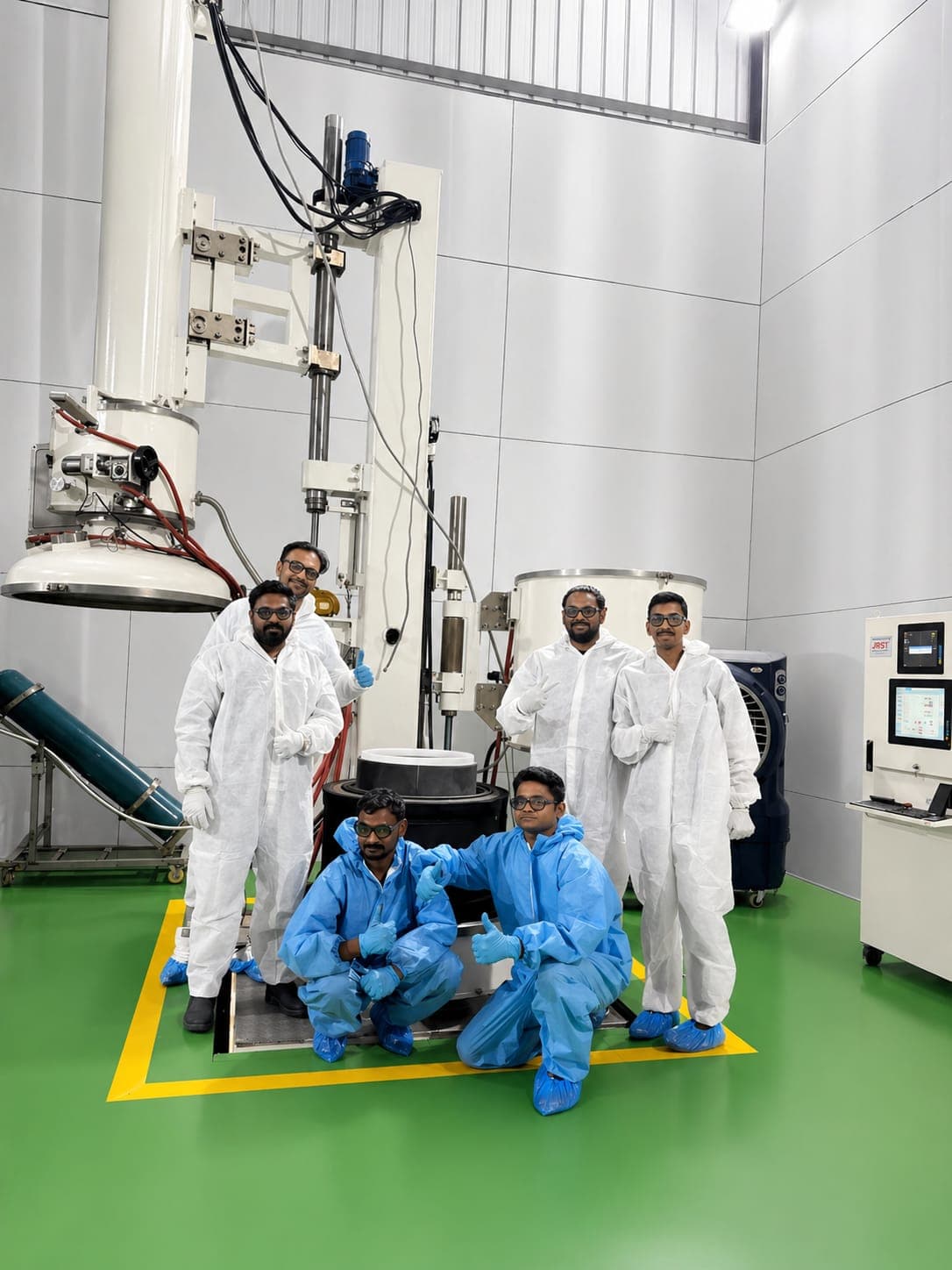
SIT pilot-batch and commissioning validation.
This image is disclosed as non-confidential project evidence from Silicon Ingot Technology's Indian facility during pilot-batch and machine-commissioning validation. JRST's role is represented as sourcing, advisory, turnkey, commissioning-support, and operating-support involvement. Full commercial production is expected after the facility completes its readiness path; this article does not claim completed mass production before that milestone.
Silicon Ingot Technology facility, India: pilot-batch and commissioning validation photo shared with approval for JRST website use.Start from the wafer customer's specification
The required device application and wafer specification should drive the ingot plan. Diameter, orientation, dopant type, resistivity, oxygen, carbon, metallic impurities, defect limits, usable length, edge exclusion, sampling, and traceability requirements influence the grower, hot zone, recipe, metrology, and handling route.
For public positioning, JRST can state that team experience includes 9N purity work in China and that India-side semiconductor-grade development is being actively advanced. Until India-side commercial qualification is complete, the stronger claim is not that India has already reached full production at scale, but that the technical understanding, equipment access, and execution discipline are being built toward that outcome.
Control the complete crystal-growth environment
Qualification depends on the combined system rather than one machine. Feedstock documentation, crucible and graphite compatibility, dopant control, chamber condition, vacuum and gas quality, thermal-field repeatability, pull and rotation control, maintenance, cleaning, and operator discipline all affect the resulting crystal.
- Qualified feedstock, dopants, crucibles, hot-zone parts, gases, and packaging
- Machine configuration, recipes, controls, calibration, alarms, and data records
- Contamination prevention, cleaning procedures, controlled handling, and change control
- Resistivity, orientation, dimensional, impurity, oxygen, carbon, and defect measurement capability
Use pilot batches to validate commissioning and process readiness
A pilot batch is not only a publicity milestone. It is a practical validation step for machine commissioning, thermal behavior, operating discipline, material handling, safety controls, and the early process window. It helps identify what must be corrected before the project moves toward repeatable output and customer-facing qualification.
For Silicon Ingot Technology, the disclosed project position is that JRST and SIT have worked together on pilot-batch and commissioning validation in India, with operational readiness targeted after remaining installation and stabilization work. This is useful evidence because it shows real facility interaction, not only a theoretical service page.
- Machine commissioning and movement checks
- Hot-zone, crucible, feedstock, gas, vacuum, and cooling validation
- Operator workflow, safety discipline, records, and traceability practice
- Engineering feedback before repeatable production and customer qualification
Plan for qualification rather than immediate volume
A new route typically progresses through equipment acceptance, engineering runs, process-window development, repeatability studies, sample preparation, customer evaluation, corrective action, and controlled ramp. Commercial planning should account for this qualification period, initial yield, consumable learning, metrology capacity, and the possibility of specification-specific changes.
India can build this capability, but claims must be evidence-led
The practical position is clear: India can understand, build, and improve this technology, but credibility comes from disciplined evidence. That means verified equipment, documented pilot work, approved technical claims, measurable quality data, trained operators, and customer-specific qualification records.
JRST's public messaging should therefore connect ambition with proof: India is moving toward stronger upstream semiconductor and solar manufacturing capability, and JRST is actively contributing through sourcing, advisory, turnkey, commissioning, operating support, and project execution.
How JRST supports this requirement
JRST can coordinate the full requirement-led route: sourcing, advisory, turnkey execution, commissioning support, operating support, qualified material and equipment options, international supplier communication, plant interfaces, pilot-batch learning, and qualification planning. Final capability, warranty, compliance, operating responsibility, and acceptance commitments are defined against the customer's documented requirement.
Discuss your requirement
Mohammed Saif Zaveri connects JRST's industrial content to execution conversations.
As Co-Founder and designated partner of JRST Technology LLP, Mohammed Saif Zaveri works across industrial growth, strategic partnerships, client conversations, equipment strategy, and project pathways for silicon, solar, semiconductor, and advanced-manufacturing opportunities.
This knowledge page is part of JRST's public industrial knowledge base, designed to help buyers move from search terms and early research toward a structured technical-commercial discussion.
View Mohammed Saif Zaveri's profileConnect on LinkedInFrequently asked questions
What is the difference between solar-grade and electronic-grade silicon?
The difference is purity and defect control. SFA (Oxford) describes solar-grade polysilicon as refined to between 6N and 9N purity (99.9999% to 99.9999999%) and electronic-grade silicon for chips as 9N to 11N (99.9999999% to 99.999999999%). Chip-grade crystal also needs much tighter control of metals, oxygen, carbon and crystal defects. Both start from quartz-derived polysilicon and are commonly grown into single crystals by the Czochralski method.
Can solar-grade silicon be used for semiconductor chips?
Generally no. Solar-grade material does not meet the purity and defect limits that integrated circuits require. Chip wafers also use different formats, typically round 200 mm and 300 mm wafers, while mainstream solar wafers are square-format sizes of about 182 to 210 mm.
Why does quartz purity matter for both solar and semiconductor silicon?
The quartz crucible that holds molten silicon during Czochralski growth is in contact with the melt for the whole run, so impurities in the quartz can transfer into the crystal. That is why crucible-grade high-purity quartz matters on both the solar and the semiconductor route.
Can JRST claim semiconductor-grade silicon ingot capability in India today?
JRST can state that its team has worked with 9N purity silicon capability in China and is actively supporting India-side development through sourcing, advisory, turnkey execution, commissioning support, operating support, and qualification planning. Any claim of India-side commercial semiconductor-grade production should be tied to completed qualification evidence.
What does a pilot batch prove?
A pilot batch can support machine commissioning, process-readiness, operator workflow, thermal behavior, material handling, and early validation. It does not by itself prove sustained commercial production or customer-qualified semiconductor-grade output.
What is required before semiconductor-grade output can be marketed confidently?
The route should have controlled feedstock and dopants, clean handling, compatible hot-zone materials, process records, metrology, impurity and defect testing, repeatability studies, customer specification alignment, and documented qualification acceptance.
What role can JRST take in such a project?
JRST can support sourcing, advisory, turnkey plant execution, commissioning support, operating support, supplier coordination, material planning, plant interfaces, and production-readiness work under a project-specific agreement.
Primary sources and further reading
Last reviewed 2026-10-14. Technical scope, policy eligibility, availability, and commercial terms should be independently confirmed for each project.