
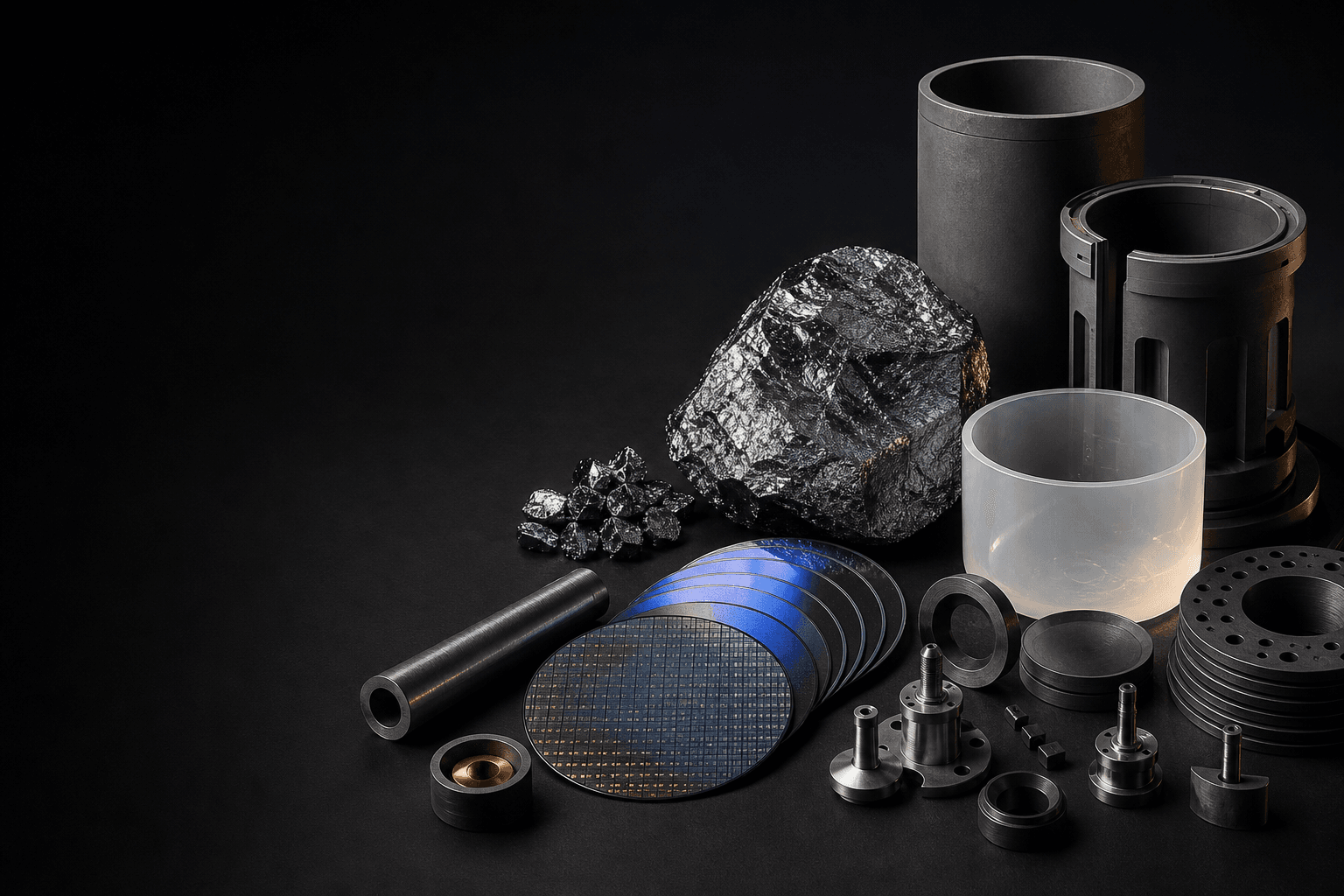
What project owners need to know.
A barium-coated quartz crucible is a fused-quartz crucible whose surface has been treated with a barium compound that acts as a devitrification promoter. During Czochralski growth, the glassy crucible wall slowly turns into cristobalite; the barium makes that happen as an even, continuous shell rather than as scattered islands that can flake off into the melt and cause dislocations in the ingot. Barium is favoured because very little of it is taken up by the growing silicon crystal. Coatings are applied by the crucible maker or before use, and the method, adhesion and handling of barium all matter. This guide summarises published patents and research; it is general industry practice, not a JRST process specification.
The problem: a glass crucible in molten silicon
In the Czochralski method, polysilicon is melted in a fused-quartz crucible just above silicon's melting point of about 1,414 °C and a single crystal is pulled from the melt. Fused quartz is glass, and at these temperatures its surface slowly crystallises into cristobalite, a process called devitrification. On a bare crucible this tends to start in scattered spots. Those islands can loosen and release particles into the melt, and a particle reaching the growing crystal can end dislocation-free growth.
Losing dislocation-free structure partway through a pull means the affected crystal has to be cut away and remelted, so crucible behaviour feeds directly into ingot yield and puller time.
What a devitrification promoter does
The counter-intuitive fix is to encourage devitrification, but evenly. A devitrification promoter is a substance on the crucible surface that seeds cristobalite across the whole treated area early in the run. The result is a thin, continuous crystalline shell instead of patchy islands. Research at NTNU on cristobalite formation on crucible inner surfaces, and patent literature from crucible and wafer makers, describe this shell as more stable against the melt and less likely to shed particles.
Why barium
Several alkaline-earth elements promote cristobalite, but they behave differently once in the melt. US Patent 5,976,247 (originally MEMC, later SunEdison) calls barium the most preferred promoter because it is not readily incorporated into the growing crystal, citing a segregation coefficient below 2.25×10⁻⁸. The same patent says calcium is unsuitable for inner surfaces because it is taken up at higher levels and can cause defects. US Patent 7,776,155 (Japan Super Quartz, now part of Sumco) notes that magnesium, calcium and strontium have larger segregation coefficients, while barium has a small one but is highly toxic.
- Low uptake into the crystal is the main reason barium is chosen
- Calcium and other alkaline-earths enter the silicon more readily
- Toxicity makes barium handling and coating adhesion a real concern
How coatings are applied
Patent literature describes several routes. US 5,976,247 describes dripping an aqueous barium hydroxide solution onto a rotating crucible, or spraying a heated crucible, with carbon dioxide converting the hydroxide to barium carbonate on the surface. During melt-down the carbonate turns into barium oxide and reacts with the silica to start the cristobalite shell.
US 7,776,155 points out a weakness of loose carbonate powder: it can rub or wash off and scatter, which is a hazard to workers. Its approach is to bake a barium-containing organic coating onto the surface, within a range of 400–1,200 °C, so the layer bonds with the glass. It notes that baking above 1,200 °C devitrifies the crucible itself. US 5,976,247 also describes treating the outer wall, and reports a further yield gain when outer and inner treatment are combined.
What it changes, and the trade-offs
The examples in US 5,976,247 report a 17.5–24.6% improvement in zero-dislocation yield from inner-surface treatment. Those are the patent holder's own trial figures, not an industry benchmark, and results depend on the sand, the crucible build and the pulling recipe. A coating cannot rescue a crucible whose inner layer has bubbles or impurities from poor sand or fusion.
The trade-offs are practical: barium's toxicity, coating uniformity and adhesion, and traceability. The patent literature also describes promoter layers based on zirconium, niobium, hafnium, tantalum or rare-earth elements, so barium is the established choice but not the only one being studied.
What buyers should ask a crucible supplier
Treat the coating as part of the crucible specification, not a hidden extra. The quartz crucible buying checklist covers the full list; for coatings, the questions below are a sensible start.
- Is the inner surface, the outer surface or both treated, and with what promoter?
- How is the coating applied and bonded, and how is uniformity checked?
- What sand grade and inner-layer construction sit under the coating?
- Is coating batch data traceable to each crucible serial number?
- What handling and disposal guidance applies to barium-treated crucibles?
How JRST supports this requirement
JRST's team works across the upstream silicon chain, including high-purity quartz sand and silicon ingot projects, and can help plant teams write crucible specifications and acceptance checks. Content here is general guidance from public sources; validate any specification with your crucible supplier and process team before you rely on it.
Discuss your requirement
Mohammed Saif Zaveri connects JRST's industrial content to execution conversations.
As Co-Founder and designated partner of JRST Technology LLP, Mohammed Saif Zaveri works across industrial growth, strategic partnerships, client conversations, equipment strategy, and project pathways for silicon, solar, semiconductor, and advanced-manufacturing opportunities.
This knowledge page is part of JRST's public industrial knowledge base, designed to help buyers move from search terms and early research toward a structured technical-commercial discussion.
View Mohammed Saif Zaveri's profileConnect on LinkedInFrequently asked questions
Why are quartz crucibles coated with barium?
A barium coating is a devitrification promoter. When the crucible heats up in the puller, it makes the glassy surface turn into an even cristobalite shell. That shell is more stable against the melt and sheds fewer particles, which supports dislocation-free ingot growth.
Why is cristobalite deliberately formed on a crucible?
Devitrification happens anyway at Czochralski temperatures. Forming it evenly and early gives a continuous shell, while uncontrolled devitrification forms islands that can flake into the melt.
Does barium contaminate the silicon ingot?
Very little. US Patent 5,976,247 cites a barium segregation coefficient in silicon below 2.25×10⁻⁸, meaning the growing crystal rejects almost all of it. That is the main reason barium is preferred over other alkaline-earth promoters.
Who applies the barium coating?
Usually the crucible maker, as a finishing step. Patent literature describes drip, spray and baked-on methods. Ingot plants should treat the coating as part of the crucible specification and ask for batch traceability.
Does a good coating make up for lower-grade quartz sand?
No. The coating controls how the surface devitrifies. Bubbles and impurities in the inner layer come from the sand and the fusion process, and a coating does not remove them.
Primary sources and further reading
Last reviewed 2026-10-28. Technical scope, policy eligibility, availability, and commercial terms should be independently confirmed for each project.