
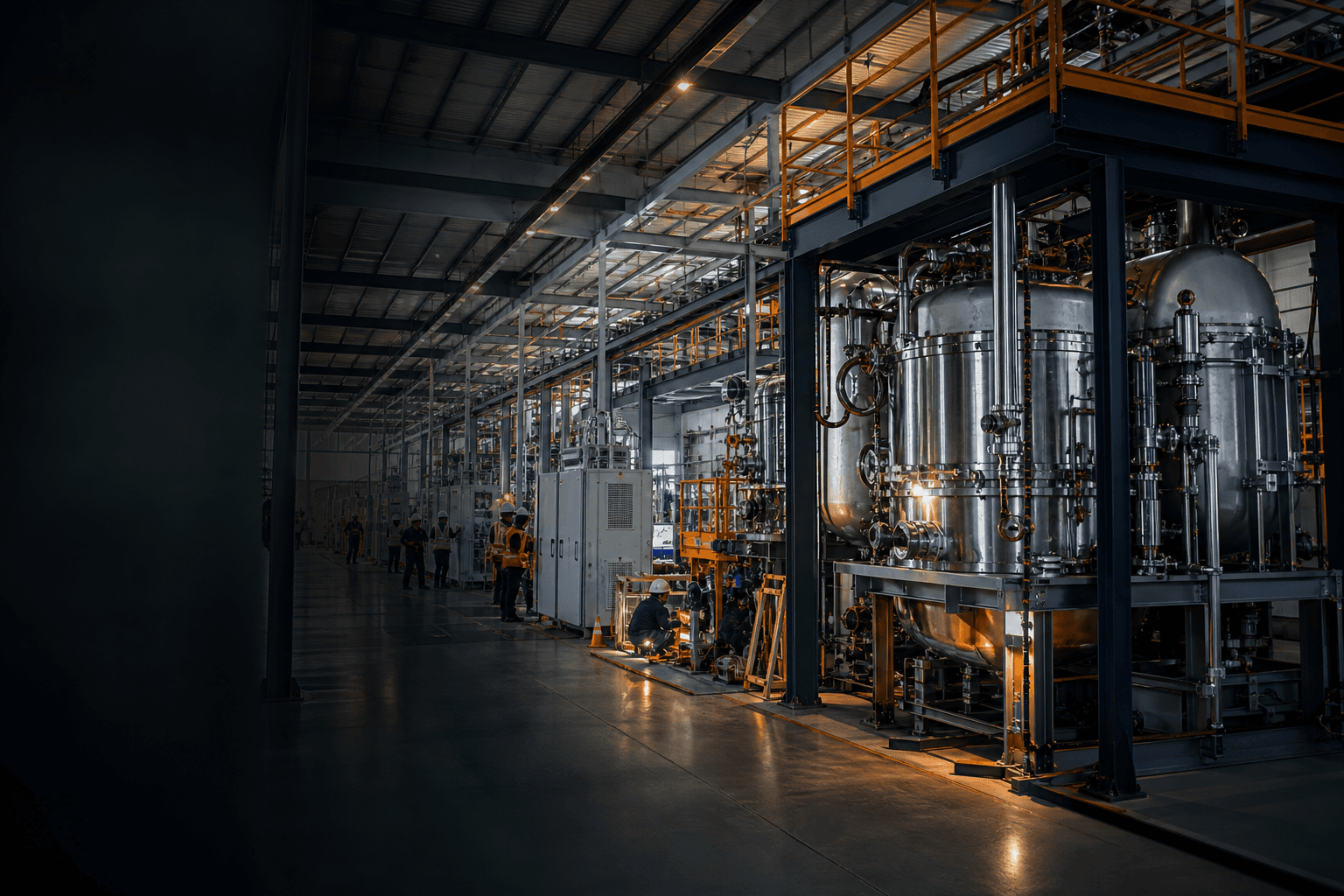
Turnkey plants across the whole silicon chain.
HPQ and UHPQS quartz-sand plants, quartz crucible plants, fused quartz tube plants, ingot-wafer plants up to 2 GW+, TOPCon solar cell lines and spare-parts manufacturing units: we take each from the business case to qualified production, commissioned by our own team.
Configured around the project, not a fixed package.
Every mandate begins with technical and commercial requirements. Individual machinery supply is available independently of a full turnkey engagement.
- 01Opportunity and business-model assessment
- 02Capacity, process, and investment planning
- 03Machine identification and supplier negotiation
- 04Inspection, import, logistics, and site coordination
- 05Layout, utilities, civil-interface, and installation planning
- 06Commissioning, training, and production stabilization
- 07Optional management, operating, or JV discussion
Equipment condition, inspection method, warranty, after-sales support, delivery schedule, and acceptance criteria are confirmed in the final supplier and JRST proposal. Manufacturer-backed warranty terms are passed through according to the selected equipment package.
Turnkey Solutions: FAQs
What does a turnkey solar or silicon manufacturing plant include?
One partner takes the project from business case to stable production: capacity and process planning, the equipment list and supplier selection, inspection and import, layout and utilities, installation, commissioning, operator training and ramp-up. The buyer receives a working line rather than a set of separate machine contracts to coordinate.
Which plants can JRST deliver on a turnkey basis?
Plants across the whole silicon chain: HPQ and UHPQS quartz-sand plants, quartz crucible and fused quartz tube plants, ingot-wafer plants, TOPCon solar cell lines and spare-parts manufacturing units. Ingot-wafer is where demand in India is strongest today, ahead of ALMM List-III for ingots and wafers from 1 June 2028.
How is a turnkey plant different from buying machines and hiring an EPC contractor?
A civil or electrical EPC contractor builds the shell and utilities, but the process risk sits with whoever matches the machines, hot zones, consumables and recipes. A turnkey process partner owns that interface, so the line is judged on output and yield at commissioning, not only on the delivery of equipment.
Can a turnkey project use refurbished or used equipment?
Yes, where it fits the business case. Refurbished crystal pullers and line tools can shorten timelines, but each machine needs inspection of its control systems, hot-zone condition and spares support before purchase. The plan states clearly which equipment is new and which is refurbished.
Who leads JRST's turnkey projects, and how do I start?
Turnkey work is led by Co-Founder & Director Mohammed Saif Zaveri with the JRST engineering and advisory team. Projects start with a discovery call and a written scope, and scope, terms and timelines are confirmed in each project proposal. Machines, spares and consumables for the line can be browsed and enquired on the JRST Buyer Portal.
Begin with the requirement, not a catalogue.