
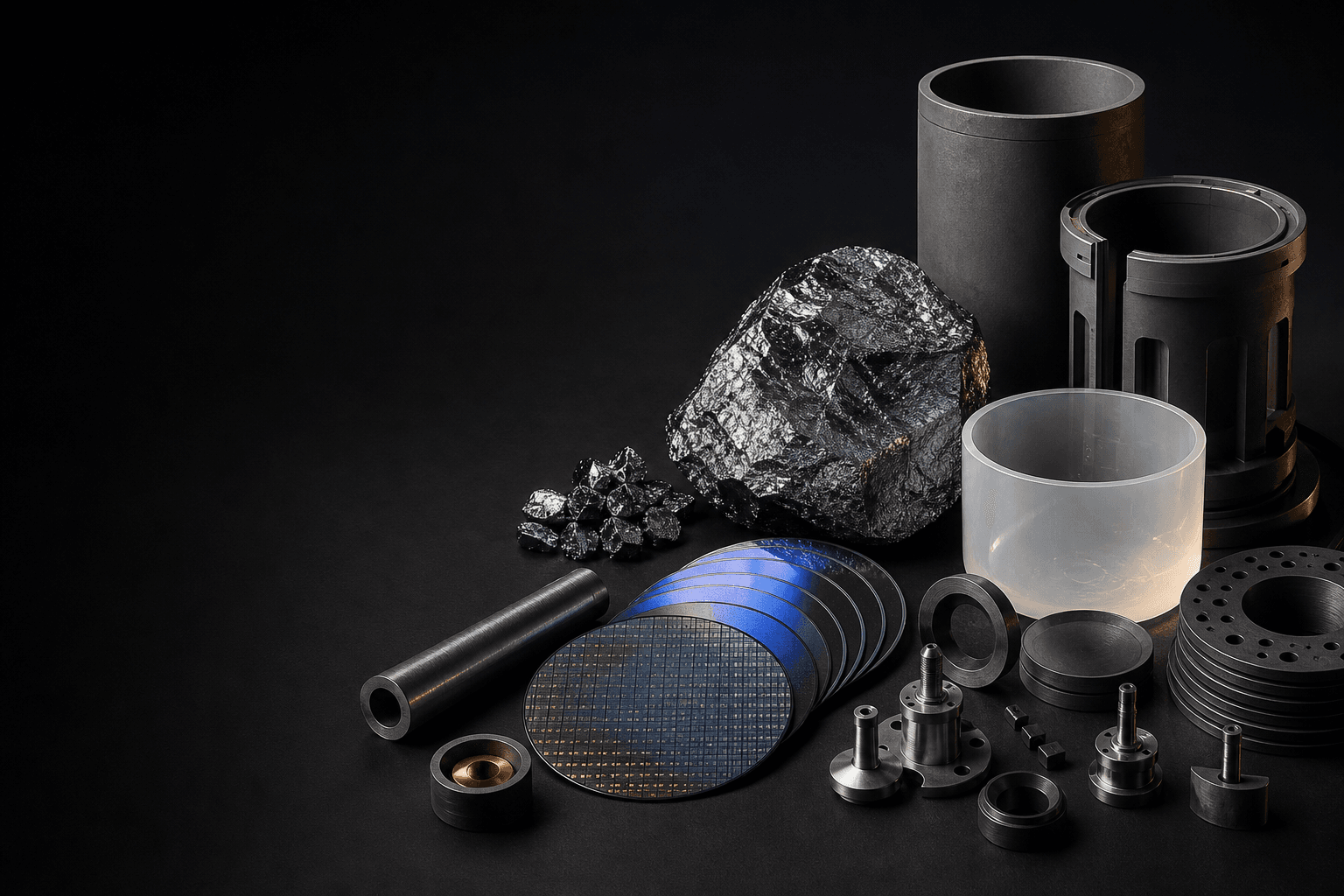
Quartz crucible and fused quartz tube plants for India's silicon chain.
Every ingot needs a crucible and every diffusion furnace needs quartz tubes. We plan and set up quartz crucible and fused quartz tube manufacturing, from HPQ sand feedstock to qualified product.
Configured around the project, not a fixed package.
Every mandate begins with technical and commercial requirements. Individual machinery supply is available independently of a full turnkey engagement.
- 01Product mix and capacity: crucible sizes, tube and quartzware ranges
- 02HPQ / UHPQS sand feedstock and qualification
- 03Arc-fusion crucible and tube-drawing equipment sourcing
- 04Quality testing: bubble, OH content, dimensional and purity checks
- 05Installation, commissioning and training
- 06Customer qualification with ingot, cell and semiconductor plants
- 07Spares and consumables supply
Equipment condition, inspection method, warranty, after-sales support, delivery schedule, and acceptance criteria are confirmed in the final supplier and JRST proposal. Manufacturer-backed warranty terms are passed through according to the selected equipment package.
Crucible & Fused Tube Plants: FAQs
How is a quartz crucible for silicon ingot growth made?
Solar and semiconductor crucibles are normally made by arc fusion: high-purity quartz sand is formed against the wall of a rotating mould and fused by an electric arc into a dense outer wall with a low-bubble inner layer. The crucible is then cut, cleaned, inspected and packed under controlled conditions. The inner layer is the critical zone, because it touches molten silicon for the whole Czochralski run.
What raw material does a quartz crucible plant need?
High-purity quartz (HPQ) sand with low and consistent levels of aluminium, alkalis, iron, titanium and boron. Many makers use a synthetic silica inner layer for premium crucibles. Feedstock qualification, with element-by-element impurity data and real fusion trials, comes before any equipment order.
How is fused quartz tube manufacturing different from crucible manufacturing?
Tubes are drawn continuously from fused quartz, typically by electric melting, then cut, annealed and finished to tight diameter and wall tolerances. They serve diffusion and oxidation furnaces in cell and semiconductor lines. Crucibles are batch-fused shapes for single use. The feedstock and quality discipline overlap, but the equipment and customer qualification differ.
Which tests decide whether a crucible or tube plant's output is accepted?
Bubble content and distribution, OH (hydroxyl) content, dimensional accuracy, impurity analysis such as ICP, and behaviour in the customer's own process: devitrification, sag and run length for crucibles, and purity and stability at temperature for tubes. Customer qualification runs are part of the project plan, not an afterthought.
Can JRST set up the plant and supply spares and consumables afterwards?
Yes. JRST Technology plans product mix and capacity, qualifies HPQ feedstock, sources fusion and tube-drawing equipment, and supports commissioning, training and customer qualification. Crucibles, quartzware and line spares can be requested on the JRST Buyer Portal. Equipment terms and timelines are confirmed in each project proposal.
Begin with the requirement, not a catalogue.