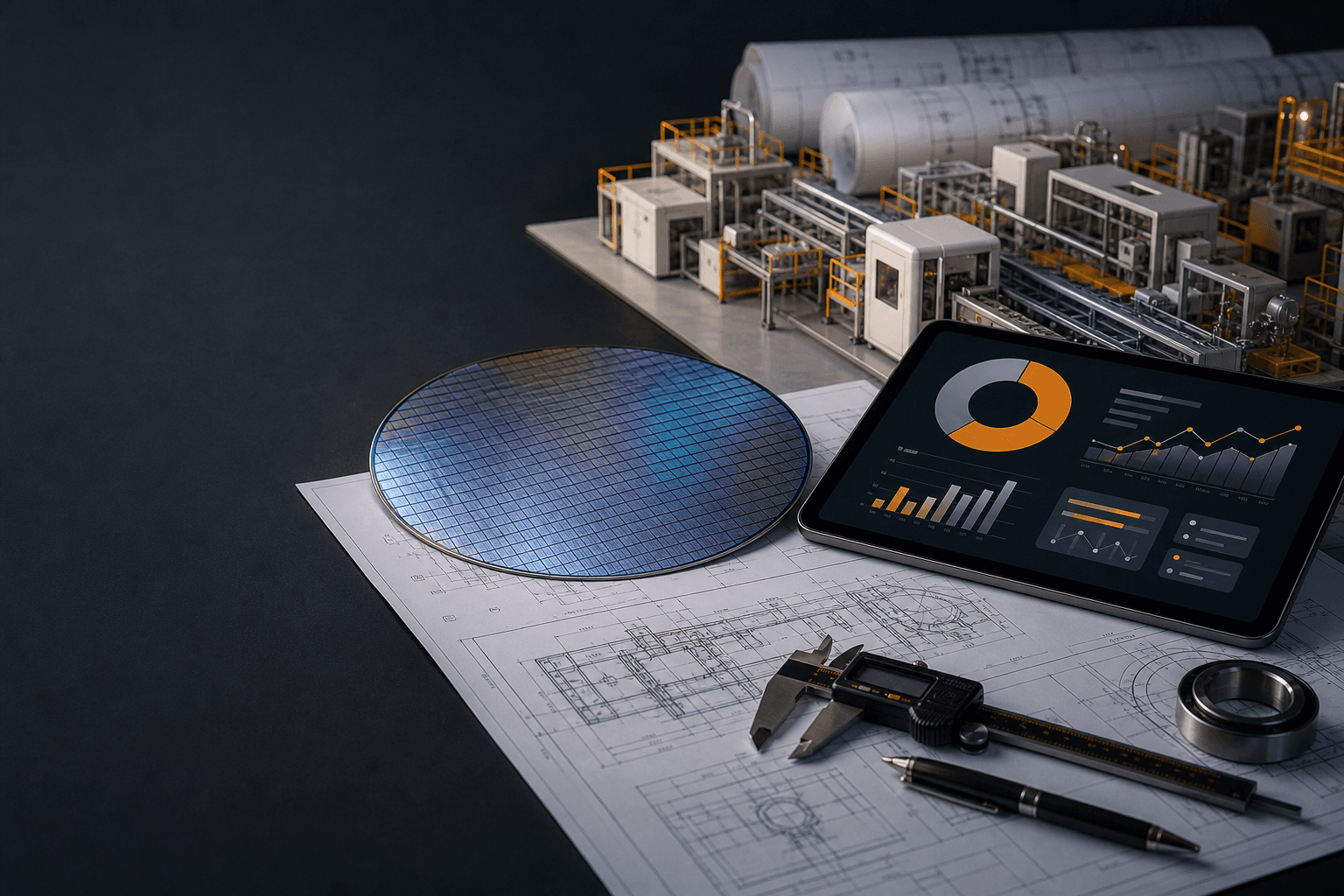
Advisory for every industry in the silicon value chain.
Ingot and wafer is where demand is strongest, but our blueprints and advisory cover the whole chain: quartz mining and testing, HPQ and UHPQS sand plants, quartz crucibles and fused quartz tubes, polysilicon, ingot-wafer, solar cell lines and spare-parts manufacturing.
Configured around the project, not a fixed package.
Every mandate begins with technical and commercial requirements. Individual machinery supply is available independently of a full turnkey engagement.
- 01Quartz mining, deposit screening and laboratory testing (ICP-MS, XRF, bubble, melt)
- 02HPQ / UHPQS sand, quartz crucible and fused quartz tube plants
- 03Polysilicon feedstock and ingot-wafer plants
- 04Solar cell lines and spare-parts manufacturing units
- 05Feasibility, technology selection, capex and returns model
- 06Equipment specification, supplier due diligence and negotiation
- 07Expansion, retrofit and operating-partner discussions
Equipment condition, inspection method, warranty, after-sales support, delivery schedule, and acceptance criteria are confirmed in the final supplier and JRST proposal. Manufacturer-backed warranty terms are passed through according to the selected equipment package.
Technical Consulting: FAQs
What does a solar or silicon manufacturing consultant actually deliver?
A plant blueprint: the product and capacity choice, the process flow, an equipment list with specifications, utilities and layout requirements, a supplier shortlist, a capex and returns model, and a project timeline. For quartz projects it starts earlier, with deposit sampling and laboratory testing. The blueprint is what investors, banks and equipment suppliers are asked to work from.
Which industries in the silicon value chain does JRST advise on?
The whole chain: quartz mining and deposit testing, HPQ and UHPQS sand plants, quartz crucible and fused quartz tube plants, polysilicon feedstock, ingot-wafer plants, solar cell lines, spare-parts manufacturing units, and semiconductor and OSAT supply. Ingot and wafer is where demand is strongest in India today, ahead of ALMM List-III from 1 June 2028.
Should a feasibility study come before ordering equipment for an ingot-wafer or cell plant?
Yes. Technology and wafer-format choices (for example n-type TOPCon on M10 or G12R wafers) fix the equipment list, and utilities such as stable power, ultra-pure water and gases often decide the site. Testing those choices on paper first is far cheaper than changing a line after machines have been ordered.
Can a consultant help evaluate refurbished or used crystal pullers and line equipment?
Yes. Refurbished equipment can shorten timelines, but it needs inspection of hot-zone condition, control systems, spare-parts availability and service support before purchase. Independent due diligence on each machine, and on the supplier, is part of the advisory scope.
Who leads JRST's consulting work, and how do I start?
JRST Technology's advisory work is led by Co-Founder & Director Mohammed Saif Zaveri with the JRST Industrial Advisory Team. Projects start with a discovery call and a written scope. Machines, spares and consumables for the planned line can also be browsed and enquired on the JRST Buyer Portal.
Begin with the requirement, not a catalogue.